


Commercial parking lots in Colorado must follow ADA Standards for Accessible Design, which require designated accessible spaces, correct van-accessible dimensions, and proper signage. Federal law mandates compliance whenever readily achievable, and non-compliant striping risks fines or lawsuits. Property managers restriping lots should verify layouts meet current standards before work begins, since Parking Lot Experts designs striping plans around these federal accessibility requirements.
Key Takeaways
- ADA Standards for Accessible Design mandate specific accessible parking space counts based on total lot capacity.
- Colorado striping regulations require proper slope and aisle width measurements to ensure wheelchair accessibility compliance.
- Accessible van spaces need 96 inches of additional width beyond standard accessible parking space dimensions.
- Parking Lot Experts ensures your Colorado commercial lot meets all ADA requirements. Call 719-465-6690 for a compliance assessment.
What Is ADA Compliance For Parking Lots?
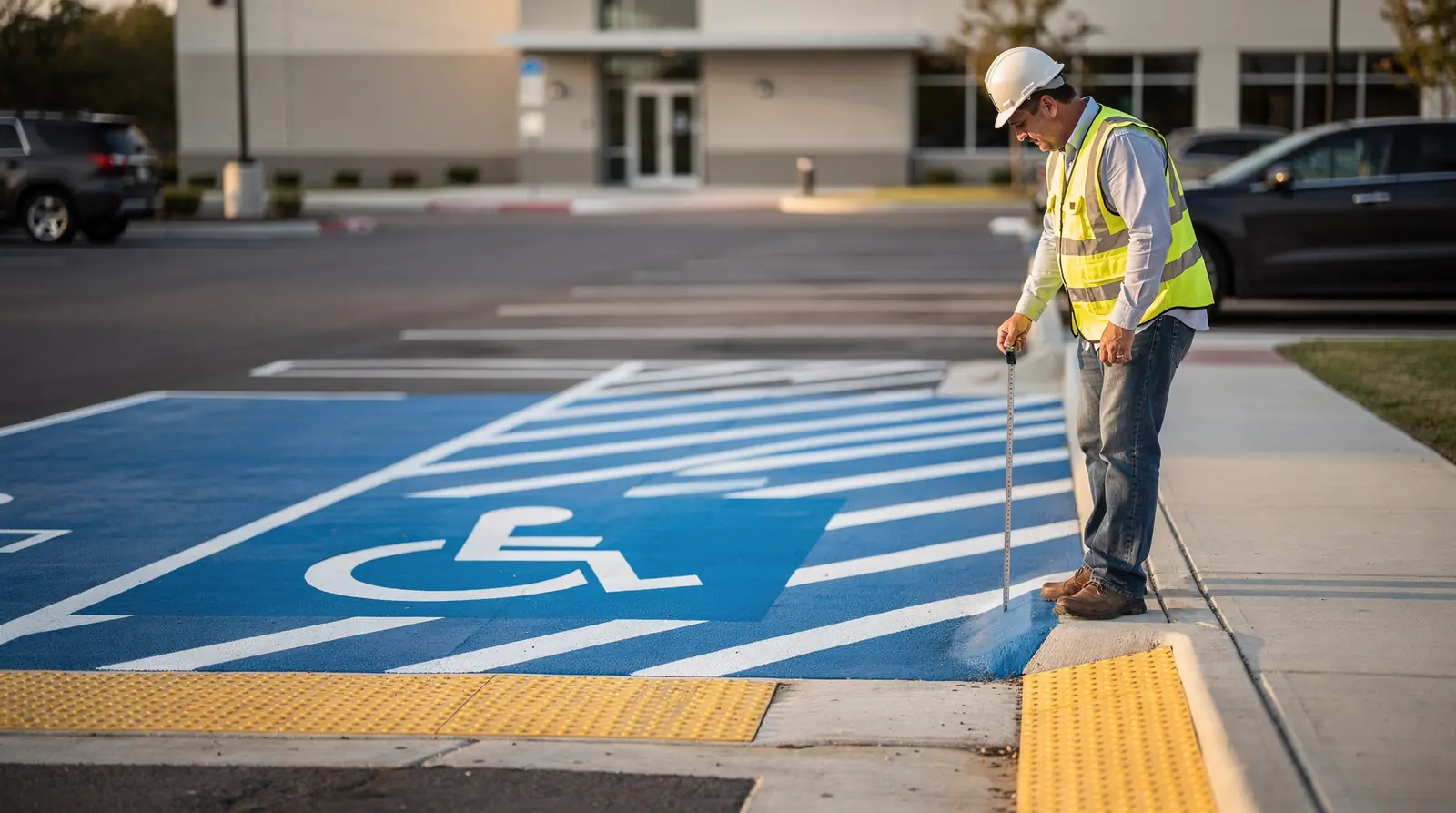
ADA compliance for parking lots means meeting federal accessibility standards governing the number, size, and placement of accessible parking spaces. Business owners and property managers who plan to stripe or re-stripe a commercial lot must understand every accessible parking space requirement before crews start painting lines. Lots that skip this review risk fines, lawsuits, and failed inspections well after the paint has dried.
Facility managers across Colorado operate under the same federal baseline as owners anywhere else in the country. ADA parking requirements Colorado property managers follow trace directly back to the Americans with Disabilities Act Standards for Accessible Design. The U.S. Department of Justice issued updated regulations in 2010, setting minimum accessibility requirements that still govern lot striping today. Those rules cover far more than a simple stall count.
What Does Compliance Actually Require?
Compliance requires matching accessible stall counts to overall lot size and keeping each space properly marked and accessible. A compliant layout typically accounts for:
- Accessible space counts tied to total parking capacity
- Van-accessible stalls paired with adequate access aisle width
- Signage height and placement at every accessible space
- Surface slope limits that keep travel paths safe for wheelchair users
How Many Accessible Spaces Must Colorado Lots Have?
Total lot size sets the minimum count of accessible stalls under ADA parking requirements Colorado property managers must follow. The math scales with capacity, so a small retail lot in Pueblo and a large distribution center near Denver face very different thresholds. Getting this number wrong exposes a facility to compliance risk long before anyone inspects paint lines or signage.
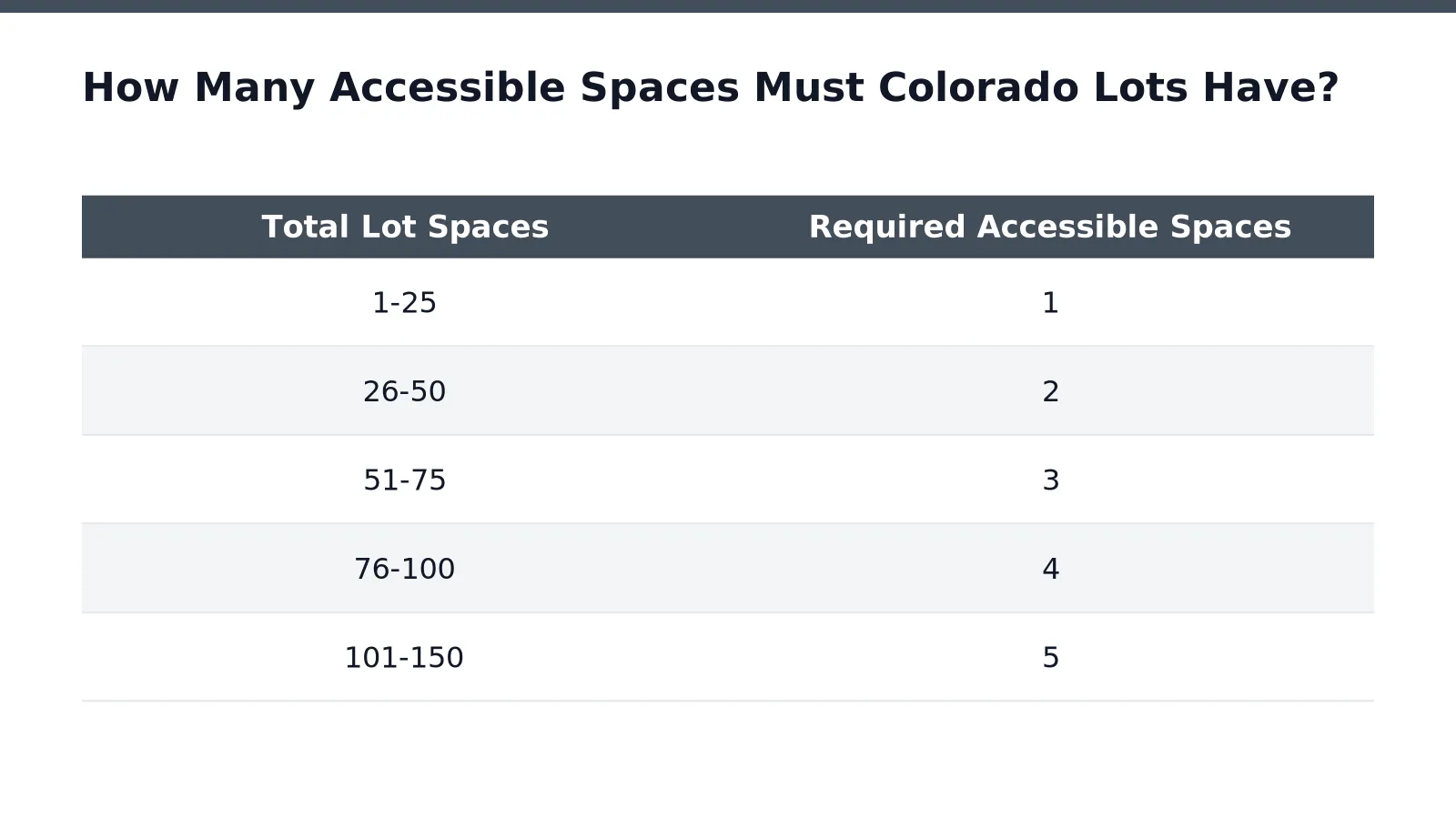
The baseline rule is simple: lots holding 1 to 25 total spaces need just one accessible stall. From there, the requirement climbs in steps rather than an apartment percentage, which trips up many facility managers who assume a single ratio applies everywhere.
| Total Lot Spaces | Required Accessible Spaces |
|---|---|
| 1-25 | 1 |
| 26-50 | 2 |
| 51-75 | 3 |
| 76-100 | 4 |
| 101-150 | 5 |
How many accessible spaces does a large Colorado lot need?
Mid-sized Colorado properties, think regional offices or shopping centers, scale upward in defined bands rather than jumping straight to a percentage formula. A lot with 26 to 50 spaces must provide two accessible stalls, while 51 to 75 spaces require three. Once a facility reaches the 76 to 100 range, four accessible spaces become mandatory, and 101 to 150 spaces call for five.
What about very large commercial lots in Colorado?
Once a Colorado lot exceeds 500 total spaces, the formula shifts from fixed counts to a percentage-based standard. Facilities above that threshold must set aside 2 percent of total spaces as accessible. This matters for commercial parking stall dimensions CO planning. Larger developments often redesign entire rows to hit that ratio without sacrificing usable parking capacity.
What Are Standard Stall Dimensions In Colorado?
Commercial parking stall dimensions co owners rely on come from a mix of municipal codes and federal accessibility law, not one statewide number. Local jurisdictions set base stall width and aisle width, while ADA parking requirements Colorado properties must meet layer on additional rules for accessible spaces.
ADA compliance parking lot Colorado Springs facilities and properties across the state cannot stop at counting how many accessible stalls exist. Accessible compliance extends further, covering van space width, required signage, surface slope, and aisle width next to each accessible stall. Skipping any one of these elements leaves a lot technically out of compliance, even if the stall count looks correct on paper.
Colorado commercial striping regulations generally require attention to the following before a crew paints a single line:
- Accurate counts of standard versus accessible stalls based on total lot size
- Adequate width for van-accessible spaces, not just standard accessible stalls
- Proper signage posted at each accessible space
- Slope limits that keep accessible routes safe and usable
- Aisle width sufficient for safe entry and exit alongside accessible stalls
How Does Colorado’s Climate Affect Stall Markings?
Properly engineered asphalt matters as much as the paint on top of it. Surfaces built with high-quality materials and designed for Colorado’s temperature swings and heavy traffic hold striping longer, since cracking and heaving distort stall lines over time.
Does Sidewalk Base Construction Change Stall Layout Durability?
Soil conditions and climate across the Pikes Peak region shape how a stall base gets built, which in turn affects how long markings stay accurate. A base tailored to regional ground conditions resists shifting, keeping stall widths and aisle spacing consistent year after year. A well-installed surface also improves curb appeal. Safety for both residential and commercial properties, supporting a layout that reads clearly to drivers.
Why Does Colorado Weather Wear Down Striping?
Colorado’s sun intensity, rapid freeze-thaw swings, and heavy seasonal traffic wear down parking lot striping faster than most property managers anticipate. Even well-built asphalt surfaces show signs of wear from sun exposure, weather, and vehicle traffic over time. Faded paint lines are usually the first visible symptom. Once markings disappear, lots risk falling out of step with ADA parking requirements in Colorado. Accessible spaces must stay clearly defined year-round.
What Causes Striping to Fade Fastest in Colorado?
UV radiation bleaches paint pigment within a few seasons. Snowplow blades, de-icing chemicals, and repeated freezing and thawing chip away at surface coatings layer by layer. Add daily traffic across standard spaces and commercial parking stall dimensions that busy lots must maintain, and the damage compounds quickly.
Weather and traffic combine to erode markings through several channels:
- Prolonged sun exposure breaking down line paint
- Winter de-icing products eating into asphalt and striping
- Freeze-thaw cycling that cracks and lifts surface layers
- Constant tire friction wearing high-traffic lanes and crosswalks
Asphalt driveways and commercial lots alike experience this same wear from traffic and weather, which gradually erodes painted markings until compliance becomes questionable. For properties managing ADA compliance parking lot Colorado Springs standards or statewide equivalents, faded lines are more than a cosmetic issue; they create liability.
When Should a Lot Be Resurfaced Before Restriping?
Surfaces showing heavy cracking, raveling, or faded color benefit from slurry seal before new paint goes down. Slurry seal, a blend of asphalt emulsion, fine aggregate, and water, renews the surface and gives fresh striping a stable, skid-resistant base. Skipping this step often means new lines fail within a single season.
Understanding Colorado’s climate challenges matters as much as understanding paint. Parking Lot Experts serves properties across the state with that regional knowledge built in, applying Colorado commercial striping regulations correctly. Lots stay compliant through harsh winters and intense summer sun alike.
What Risks Come With Non-Compliant Striping?
Non-compliant striping exposes Colorado property owners to federal penalties, legal action, and costly rework. Federal law requires businesses and public entities to correct accessibility violations whenever correction is readily achievable. Failure to meet these obligations can trigger fines or lawsuits, regardless of a property’s size or location.
ADA compliance parking lot Colorado Springs standards treat striping corrections as a low-cost fix, which raises the compliance bar rather than lowering it. Because the Americans with Disabilities Act considers striping and re-striping relatively inexpensive, enforcement agencies classify compliance as readily achievable in nearly every situation. Property managers cannot claim financial hardship as an excuse when the fix itself costs so little compared to the surface repaving or redesign work it prevents.
Why does readily achievable status matter for property owners?
Readily achievable status removes the most common legal defense available to non-compliant properties. Once striping is classified as low-cost, courts and enforcement bodies expect correction without delay. This standard applies across Colorado, from small retail lots to large commercial campuses.
The risks compound when Colorado commercial striping regulations go unaddressed over multiple seasons:
- Federal fines assessed per violation, per inspection cycle
- Civil lawsuits filed by patrons denied accessible access
- Forced emergency restriping during peak business hours
- Reputational damage tied to public accessibility complaints
Does enforcement differ across Colorado cities?
Enforcement applies uniformly wherever ADA jurisdiction extends, including Colorado Springs, Denver, and surrounding communities. Parking Lot Experts serves these same regions, where property owners face identical federal compliance obligations regardless of municipal boundaries. A lot in one city carries the same exposure as one across the state.
Delaying correction rarely reduces cost. It typically increases it, turning a routine striping update into a legal liability.
When Should Parking Lots Be Re-Striped?
Faded lines, cracked sidewalk, and outdated accessible space layouts signal that a parking lot needs re-striping. Property managers across Colorado Springs and Denver should schedule this work before worn markings create safety hazards or compliance gaps. Waiting too long often turns a routine maintenance task into a larger repair project.
Before any re-striping begins, owners should confirm they understand current accessible space requirements under ADA compliance parking lot Colorado Springs standards. Federal guidelines govern the number, placement, and dimensions of accessible stalls. These rules apply whenever a lot is restriped, not just during new construction. Reviewing ADA parking requirements Colorado ahead of a project avoids costly rework later.
How Can Property Managers Tell a Lot Needs New Striping?
Several warning signs point to an overdue striping project. A facility manager scanning the lot should watch for:
- Lines that have faded to the point of being hard to see from a distance
- Sidewalk cracking or alligatoring near existing stall markings
- Stall layouts that no longer reflect current commercial parking stall dimensions co standards
- Accessible spaces positioned incorrectly relative to building entrances
Any of these conditions calls for prompt attention rather than delay.
Does Sidewalk Condition Affect Striping Timing?
Sidewalk surface quality directly affects how long new striping lasts. A slurry seal application offers a cost-effective way to protect. Renew asphalt before more expensive repairs or re-striping become necessary. This treatment smooths minor surface wear and creates a stable base for new paint.
Using premium materials and professional application techniques produces a consistent, long-lasting finish that supports durable striping. Lots maintained with this approach, paired with attention to Colorado commercial striping regulations, tend to hold clean, compliant lines longer between projects.
Which Colorado Areas Enforce These Striping Rules?
Striping standards apply across a wide span of Colorado, not just within a single city limit. ADA parking requirements Colorado-wide extend to every municipality where commercial properties welcome the public, from small mountain towns to major metro corridors.
Coverage spans Colorado Springs, Manitou Springs, Fountain, Monument, Woodland Park, Castle Rock, and Denver. Each of these cities enforces the same federal accessibility framework for commercial lots, meaning a property manager in Woodland Park faces the identical baseline obligations as one in Denver. The geography varies; the compliance expectations do not.
A provider based in Colorado Springs, CO, sits in a useful position relative to these jurisdictions. Proximity to the Front Range corridor allows faster response for striping projects that need to meet ADA compliance parking lot Colorado Springs standards without long travel delays. That matters for facility managers juggling tight maintenance windows.
Does county matter for parking lot compliance?
County lines do shape how local permitting and inspection processes unfold, even though ADA rules themselves are federal. Service reaches El Paso County, Teller County, Douglas County, Arapahoe County, and Denver County, illustrating how broadly these compliance expectations stretch across the region. A business in Arapahoe County and one in Teller County both answer to the same accessibility baseline, but local permitting steps can differ.
Why does enforcement reach so many towns at once?
Commercial properties of nearly every size, from retail plazas to office parks, fall under the same accessibility mandate once they offer public parking. That mandate doesn’t shrink for smaller towns like Fountain or Manitou Springs.
Property managers should also track Colorado commercial striping regulations alongside commercial parking stall dimensions co standards. Both intersect wherever vehicles and pedestrians share sidewalk:
- Municipal boundaries: Colorado Springs, Manitou Springs, Fountain, Monument, Woodland Park, Castle Rock, Denver
- County jurisdictions: El Paso, Teller, Douglas, Arapahoe, Denver
Who Can Guide Compliance For Property Managers?
Property managers researching ada compliance parking lot colorado springs rules benefit most from sidewalk contractors who combine construction expertise with knowledge of accessibility codes. Parking Lot Experts provides expert asphalt installation and construction services across Colorado Springs for homeowners, businesses, property managers, and commercial facilities, giving managers a single point of contact for both paving work and compliance-related layout questions. That dual expertise matters because ADA parking requirements Colorado standards intersect directly with commercial parking stall dimensions co codes and broader Colorado commercial striping regulations governing line placement, signage, and access aisles.
Who should a property manager call about striping compliance?
Managers with questions on compliance-related paving and striping needs can call Parking Lot Experts directly at +1 719-465-6690. Phone consultations allow property managers to describe their lot’s current layout. Get direction on next steps before any work begins.
What are the office hours for compliance consultations?
Consultations are available Monday through Friday, from 8 a.m. to 4 p.m.
FAQ
How many accessible spaces does a 76-100 space lot require?
Colorado commercial lots with 76 to 100 total spaces require 4 accessible stalls under ADA Standards for Accessible Design, following the step-based scaling rather than an apartment percentage.
How much extra width do van-accessible spaces need?
Accessible van spaces require 96 inches of additional width beyond standard accessible parking space dimensions, ensuring adequate access aisle space for wheelchair users.
Who ensures Colorado parking lots meet ADA requirements?
Parking Lot Experts designs striping plans around federal accessibility requirements for commercial lots in Colorado Springs, Denver, and surrounding areas. Call 719-465-6690 for a compliance assessment.
Conclusion
In closing, maintaining ADA compliance and adhering to Colorado striping regulations protects your business from liability while ensuring accessibility for all visitors. These standards reflect a commitment to both legal responsibility and inclusive design. Parking Lot Experts understands the complexities of these requirements and delivers solutions that meet current regulations while enhancing your property’s functionality and appearance. Proper striping and compliance work today prevents costly corrections tomorrow, making professional expertise a sound investment in your commercial parking lot’s long-term success.

