


Parking Lot Experts in Colorado Springs, CO optimizes commercial lots using ADA-compliant striping, directional arrows, and clear signage to maximize space efficiency and traffic flow. Serving Colorado Springs, Denver, and surrounding areas, they schedule professional striping Monday-Friday, 8 am–4 pm; call 719-465-6690 for a consultation.
Crisp, properly planned striping maximizes stall capacity, meets ADA accessibility requirements, and prevents the confusion and liability risks that come with faded lines. Parking Lot Experts serves Colorado Springs, Denver, and surrounding areas Monday–Friday, 8 am–4 pm. Call 719-465-6690 to inquire about scheduling a traffic flow assessment.
Commercial parking lot striping establishes clear traffic flow, defined stalls, and ADA-compliant accessible spaces that reduce liability and confusion. Parking Lot Experts delivers professional striping and marking services across Colorado Springs, pairing crisp layouts with durable asphalt paving and sealcoating to keep facilities safe, organized, and compliant for property managers and business owners alike.
Key Takeaways
- Proper parking lot striping maximizes space efficiency and establishes clear directional flow for vehicles and pedestrians.
- Well-maintained line markings reduce confusion, improve safety, and create positive first impressions for clients and visitors.
- Professional striping layouts meet legal standards while organizing vehicular movement through designated parking spaces and traffic patterns.
- Faded or outdated striping causes inefficiencies and safety hazards, requiring regular maintenance and professional restriping services.
What Is Parking Lot Striping and Why Does It Matter?
Parking lot striping Colorado Springs refers to the painted lines, symbols, and markings that organize how vehicles move and park across a commercial lot. Crisp, well-placed markings guide traffic, define stall boundaries, and squeeze the maximum number of vehicles into available sidewalk. Without that structure, drivers guess where to go and where to stop, which rarely ends well.
The stakes run higher than most property managers assume. Faded or chaotic layouts invite confused traffic patterns, door dings, pedestrian hazards, and legal liability exposure that can land directly on the property owner’s desk. A lot that looks disorganized from the street signals neglect before a single customer walks through the door.
Why Does Striping Affect First Impressions?
Striping is often the very first detail a visitor notices on arrival, long before they reach the entrance. A clean, logical layout communicates that a property is organized, safe, and easy to navigate. A faded or mismatched one raises doubt before any business is conducted.
Effective parking stall layout design does more than mark boundaries. It shapes how smoothly vehicles and pedestrians share the same space. Thoughtful commercial parking lot marking typically addresses:
- Stall dimensions that match vehicle types and local accessibility requirements
- Directional arrows that prevent head-on conflicts between entering and exiting traffic
- Pedestrian crossings and curb markings that separate foot traffic from vehicles
- Fire lanes and loading zones kept clear for emergency and delivery access
Does Striping Improve Traffic Flow?
Yes. Strategic traffic flow optimization parking lot planning reduces congestion by directing vehicles along predictable paths instead of leaving navigation to chance. Clear lane markings cut down on near-misses at intersections within the lot and speed up turnover during peak hours.
Property managers who treat striping as routine maintenance, rather than an afterthought, protect both safety and curb appeal. Parking Lot Experts approaches striping as one piece of a broader sidewalk strategy that keeps Colorado Springs properties functional year-round.
Why Does Striping Shape a Visitor’s First Impression?
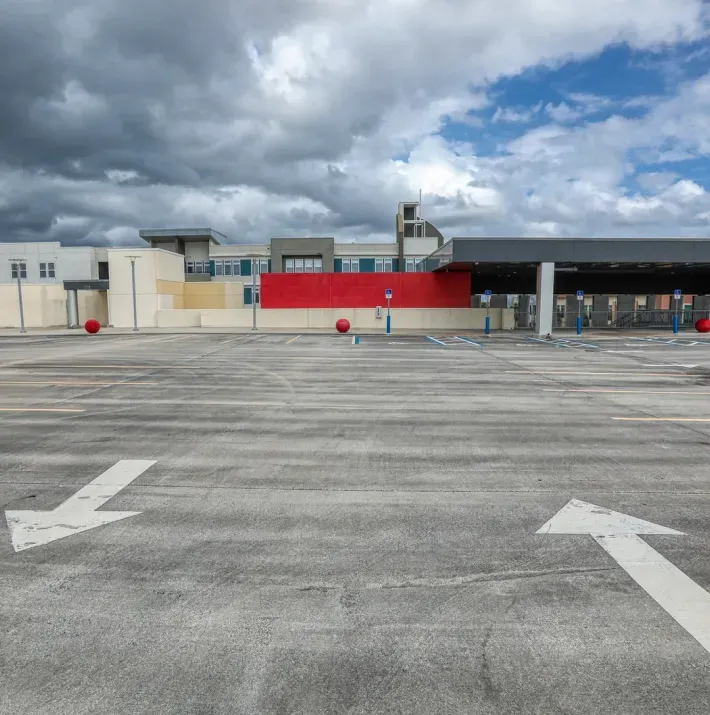
Entering a commercial parking facility marks the very first physical interaction clients, employees, and visitors have with a business or institutional property. Before anyone walks through the front door, the sidewalk itself sends a message. Faded lines, inconsistent spacing, or a confusing layout suggest neglect. Crisp parking lot striping Colorado Springs property managers can count on signals order and care. That visual cue sets expectations long before a customer reaches the counter or a tenant reaches the lobby.
Beyond appearances, clearly defined markings guide traffic, reduce driver confusion, and lower the risk of accidents in busy lots. A well-planned parking stall layout design keeps vehicles moving in predictable patterns and reduces the stop-and-start conflicts that frustrate drivers searching for open spots. Thoughtful commercial parking lot marking also separates pedestrian walkways from vehicle lanes, cutting down on close calls near entrances.
Does striping affect how customers judge a business?
Yes. A property’s sidewalk condition often shapes perception before any service is rendered. Clean, visible lines read as professionalism and attention to detail, while cracked or faded markings raise doubts about overall maintenance standards.
What role does layout play in daily operations?
Proper traffic flow optimization parking lot planning reduces congestion during peak arrival and departure times. Facility managers who prioritize layout design typically see fewer complaints about blocked lanes or confusing circulation patterns.
Property types vary widely, and striping needs shift accordingly:
- Retail centers require high-visibility crosswalks and frequent turnover zones.
- Municipal lots need clear accessibility markings and durable paint for heavy use.
- Residential properties often prioritize simple, low-maintenance layouts.
Parking Lot Experts works across commercial, residential, and municipal properties, giving property managers a single resource for varied striping needs. Client feedback has noted staff professionalism and smooth project execution, reinforcing that a well-marked lot starts with a well-managed process.
How Does Stall Layout Design Maximize Capacity?
Parking stall layout design maximizes capacity by converting raw square footage into an organized grid of usable spaces. Planning starts with measuring the lot’s total length and width, a calculation that determines exactly how many stalls a property can realistically support. Skipping this step leads to wasted square footage or, worse, an undersized layout that turns away visitors during peak hours.
Capacity, though, means more than stall count. A layout works best when several elements function together as one system:
- Parking stalls sized for standard and accessible vehicles
- Driving aisles wide enough for two-way or one-way movement
- Entry and exit points positioned to prevent bottlenecks
- Pedestrian pathways that keep foot traffic separate from moving cars
Leaving out any one of these pieces creates friction elsewhere in the lot, even if stall count looks sufficient on paper.
Colorado Springs properties face an added variable: terrain and climate. Soil conditions across the Pikes Peak region shift seasonally. Freeze-thaw cycles stress sidewalk in ways flatter, milder climates never experience. Layout plans that ignore these regional factors risk premature cracking and uneven stall boundaries within just a few seasons.
Does Stall Layout Differ by Property Type?
Yes. A commercial parking lot marking plan built for a retail center won’t match one designed for a municipal lot or a residential complex. Traffic volume, vehicle turnover, and peak-hour demand all vary by property type, so stall dimensions and aisle widths need to flex accordingly.
What Happens When Layout Planning Gets Skipped?
Properties that stripe without a layout plan often end up with mismatched stall counts, cramped aisles, or confusing entry points. The result is lost capacity, frustrated drivers, and higher long-term repaving costs once the pattern needs correcting.
What ADA Rules Govern Parking Lot Markings?
Federal Americans with Disabilities Act standards set a minimum accessible stall count tied directly to total lot capacity. A facility with 1 to 25 standard spaces, for example, must provide one accessible space within that total. Larger lots scale upward from that baseline, so capacity drives the exact accessible-space requirement.
Facility managers cannot treat ADA compliance as an afterthought once paint hits sidewalk. Local zoning ordinances often layer additional requirements on top of federal rules. The two must be reconciled before any commercial parking lot marking work begins. Skipping this research step risks a layout that looks finished but fails inspection.
How does accessible stall count scale with lot size?
The required number of accessible spaces rises as total parking capacity grows, following a tiered formula rather than a apartment percentage. A property manager overseeing a 25-space lot faces a different accessible-stall obligation than one managing a 300-space structure. Confirming the current tier against actual space count prevents costly restriping later.
Does compliance vary by jurisdiction?
Yes. Municipal accessibility codes differ across counties, so a layout approved in one jurisdiction may not satisfy another. Parking Lot Experts serves El Paso, Teller, Douglas, Arapahoe, and Denver counties, regions where local code requirements are far from uniform. Property owners operating across county lines should verify each site separately rather than assuming one compliant design transfers everywhere.
Planning for ADA accessibility typically involves:
- Calculating total space count before finalizing parking stall layout design
- Cross-checking local zoning language against federal ADA minimums
- Verifying accessible-space ratios against current lot capacity, not original blueprints
- Reassessing compliance whenever a lot is resurfaced or reconfigured
For portfolios spanning multiple states or municipalities, broader consulting resources exist through platforms such as National Parking Lot Experts, which focuses on asset management, ADA compliance review, and contractor coordination at a national scale.
How Does Marking Improve Traffic Flow?
Organized sidewalk markings direct drivers through a property without hesitation or guesswork. A well-planned layout keeps vehicles moving efficiently, cuts down on congestion, and makes entering, parking, and exiting simple for every visitor. Confusion at the entrance or in a crowded aisle slows everyone down and raises the odds of a fender bender.
Commercial parking lot marking does more than mark boundaries; it creates a visual language drivers understand instantly. Arrows signal direction, stop bars control intersections, and painted lane lines prevent vehicles from drifting into oncoming traffic. Without this structure, drivers hesitate, double back, and create bottlenecks that ripple through the entire lot.
Does Better Striping Actually Reduce Accidents?
Research from the Federal Highway Administration supports a direct link between marking visibility and safety outcomes. A 50-unit increase in white edge-line retroreflectivity, the measure of how brightly a line reflects headlights back to a driver, corresponded with an 18% drop in nighttime target crashes. That finding applies to roadways generally, but the underlying principle holds for commercial lots too: brighter, well-maintained lines help drivers see boundaries before a mistake happens.
What Makes a Layout Flow Well?
Smart parking stall layout design accounts for how vehicles actually move through a site, not just how many stalls fit on paper. Traffic flow optimization in a parking lot depends on a few consistent elements:
- One-way arrows that eliminate head-on conflicts in tight aisles
- Clearly separated pedestrian paths away from vehicle lanes
- Consistent stall widths that prevent door-ding disputes
- Visible stop bars at every intersection point
Property managers across Colorado Springs, Denver, and the surrounding areas depend on parking lot striping Colorado Springs professionals who understand how local traffic patterns and seasonal wear affect marking durability. A layout that functions well in October can fade and confuse drivers by spring without proper upkeep.
What Materials Keep Striping Durable?
High-grade paint formulations, applied with precision equipment and backed by sound surface preparation, keep commercial parking lot marking visible and functional for years rather than months. Material quality determines whether lines survive a Colorado winter or fade into illegible ghosts by spring. Selecting the wrong paint, or skipping proper surface prep, invites early cracking, chipping, and color loss that forces facility managers into costly re-striping long before a normal maintenance cycle would require it.
Premium materials paired with professional application techniques produce a finish that stays consistent across an entire lot. Holds up over repeated seasons of freeze-thaw cycles and heavy vehicle traffic. Cutting corners on either element shows up fast, usually as uneven line widths or paint that peels within a single season.
Surface treatments play a similar role in material durability. A properly applied slurry or sealcoat treatment creates a smooth, skid-resistant surface that restores both the appearance and the structural performance of the underlying asphalt, giving fresh striping a stable base to bond with.
Why Does Paint Selection Matter So Much for Striping Longevity?
Paint grade affects adhesion, flexibility, and resistance to UV exposure and traffic wear. Lower-grade paints often lack the binding agents needed to withstand freeze-thaw stress common in Colorado Springs, leading to premature cracking.
Durable, long-lasting sidewalk markings depend on careful preliminary planning, precise spatial layout calculations, and high-grade paint selection working together. Skipping any one of these steps compromises the entire system. Even premium paint fails on a poorly measured or improperly prepped layout.
Key material considerations include:
- Paint formulated for extreme temperature swings and freeze-thaw cycling
- Reflective or high-visibility additives for low-light legibility
- Surface treatments applied before striping to ensure proper adhesion
- Application equipment calibrated for consistent line width and thickness
Facility managers who prioritize material quality upfront avoid the recurring expense. Liability exposure that come with chronically faded, confusing parking stall layout design.
How Does Colorado’s Climate Affect Striping Longevity?
Sun exposure, freeze-thaw cycles, and heavy vehicle traffic wear down asphalt surfaces across the Front Range year-round. Faded lines and cracked sidewalk follow close behind, shortening the life of any parking lot striping Colorado Springs property depends on for safe navigation. Front Range weather swings from intense UV radiation at altitude to sudden hailstorms. Winter freeze, each cycle stressing the asphalt binder that holds painted lines in place.
Parking stall layout design suffers first when surface wear sets in, since faded boundary lines blur stall dimensions and confuse drivers searching for open spaces. A commercial parking lot marking program loses its value quickly once stripes fade past legibility, forcing facility managers into repeat projects sooner than planned. Addressing surface wear early, before cracks and fading compound into structural damage, keeps repair costs lower over the life of the sidewalk.
Why Does Slurry Seal Matter for Striping Longevity?
Slurry seal application protects asphalt before weather damage reaches the point of costly repair. The treatment renews sidewalk surfaces and creates a stable base that holds paint and markings longer, which directly supports traffic flow optimization parking lot goals by keeping directional arrows and stall lines visible.
Does Local Climate Knowledge Change Maintenance Timing?
Regional climate patterns vary enough across Colorado that generic maintenance schedules fall short. Parking Lot Experts brings familiarity with the specific weather. Sidewalk challenges found in the Pikes Peak region, informing when resurfacing or restriping should happen.
Service coverage spans a range of elevations and microclimates:
- Colorado Springs
- Manitou Springs
- Fountain
- Monument
- Woodland Park
- Castle Rock
- Denver
Each location experiences a distinct mix of sun intensity, snowfall, and temperature swings, all of which shape how quickly markings deteriorate and how often maintenance should occur.
What Does a Professional Striping Process Involve?
A professional striping process begins long before paint touches sidewalk. Qualified contractors evaluate existing surface conditions, confirm parking stall layout design against property needs, and schedule work to minimize disruption for tenants and customers. This process often extends beyond paint alone, bundling parking lot striping Colorado Springs projects with related sidewalk work such as asphalt paving, concrete paving, sealcoating, crack repair, and site preparation. Combining these services during one project reduces the number of separate contractor visits a property manager needs to coordinate.
Faded lines and outdated layouts create real problems for the people who manage a lot. When markings wear down, confusion spreads among drivers, traffic slows, and safety risks rise for pedestrians moving between vehicles. A clear commercial parking lot marking plan prevents this gradual decline before it affects daily operations.
How does scheduling typically work for striping projects?
Most striping work gets scheduled and discussed during standard weekday business hours, Monday through Friday from 8 a.m. to 4 p.m. This window allows property managers to coordinate timing with staff schedules, delivery hours, and customer traffic patterns. Clear communication during these hours also helps avoid surprises once crews arrive on site.
What should property managers expect during the quoting stage?
Expect direct answers and a clear scope of work before any striping begins. Many clients describe the quoting process as responsive, with questions addressed promptly and project details explained in plain terms rather than technical jargon.
A well-executed striping plan supports traffic flow optimization parking lot goals by directing vehicles logically through entry points, drive aisles, and designated stalls. Markings typically include:
- Directional arrows at entrances and exits
- Painted stall lines sized to local standards
- Accessible parking symbols and crosswalks
- Fire lane and no-parking zone markings
Each element works together to reduce congestion and improve safety across the lot.
FAQ
Why does parking lot striping matter for commercial properties?
Striping organizes traffic flow, defines stalls, and ensures ADA compliance, reducing confusion and liability risks. Faded or chaotic layouts create safety hazards and signal neglect to visitors and customers.
How does striping improve traffic flow in a parking lot?
Strategic striping directs vehicles along predictable paths, cutting down on near-misses at intersections and speeding up turnover during peak hours. Clear lane markings replace guesswork with organized, efficient movement.
Who can schedule a parking lot striping assessment with Parking Lot Experts?
Property managers and business owners in Colorado Springs, Denver, and surrounding areas call 719-465-6690 Monday–Friday, 8 am–4 pm. Parking Lot Experts serves commercial, residential, and municipal clients.
Conclusion
In closing, strategic parking lot striping and traffic flow optimization represent essential investments in property safety, compliance, and operational efficiency. Well-designed markings guide drivers intuitively, reduce liability exposure, and enhance the professional appearance of your facility. Whether you manage a commercial property, residential complex, or municipal space, prioritizing clear sidewalk markings demonstrates commitment to patron safety and site management excellence. Professional striping solutions deliver lasting results that protect your investment and improve the user experience for years to come.

