


Civil-Engineered Rigid Flatwork, High-Strength 4,500+ PSI Mix Chemistry, Structural Heavy-Axle Slabs, and Freeze-Thaw Resistant Municipal Infrastructure. Serving Commercial Property Managers, Facility Engineers, Industrial Logistics Directors, and Commercial General Contractors Across Colorado Springs, El Paso County, and the Pikes Peak Region.
Heavy-Duty Commercial Concrete Solutions in the Pikes Peak Region
In commercial real estate and industrial facility management across Colorado Springs, pavement infrastructure must satisfy two competing demands: flexible cost-efficiency over vast vehicle parking stalls, and unyielding structural rigidity under concentrated point loads and chronic moisture channels.
While asphalt represents the standard wearing surface for broad parking fields—as detailed in our Commercial Parking Lot Paving Services in Colorado Springs cornerstone hub—commercial concrete is an irreplaceable civil engineering requirement for high-stress zones. Where flexible asphalt shoves, ruts, and unravels under the continuous shear stresses of turning semi-trucks, high-impact refuse loading, and stationary landing gear, rigid Portland cement concrete distributes those immense stresses across an engineered slab foundation.
The Front Range Engineering Reality
Pouring commercial concrete in Colorado Springs is fundamentally different from sea-level or temperate construction. Operating at 6,000 to 7,000+ feet above sea level, commercial flatwork in El Paso County confronts an exceptionally hostile structural environment:
- 150+ Annual Freeze-Thaw Thermal Cycles: Extreme diurnal temperature swings force moisture inside unsealed pore structures to expand by 9%, generating internal bursting pressures exceeding 2,000 PSI.
- Expansive Bentonite Clay Formations: The Dawson and Denver geologic formations across eastern Colorado Springs feature high-plasticity montmorillonite clay subgrades that exert vertical swell pressures exceeding 5,000 to 10,000 PSF when saturated.
- Aggressive Deicing Salt Attack: Frequent applications of magnesium chloride, calcium chloride, and rock salt induce chemical degradation, osmotic pressures, and catastrophic surface scaling.
- Accelerated Solar Desiccation: Thin high-altitude air accelerates surface evaporation during placement, requiring strict ACI curing controls to prevent plastic shrinkage cracking.
At Parking Lot Experts, we provide complete turnkey commercial concrete engineering, installation, structural repair, and ADA compliance services. From 8-inch fiber-reinforced industrial loading aprons to laser-guided slip-form curb and gutter systems, our civil teams engineer concrete infrastructure designed to deliver 30 to 40+ years of maintenance-free service life.
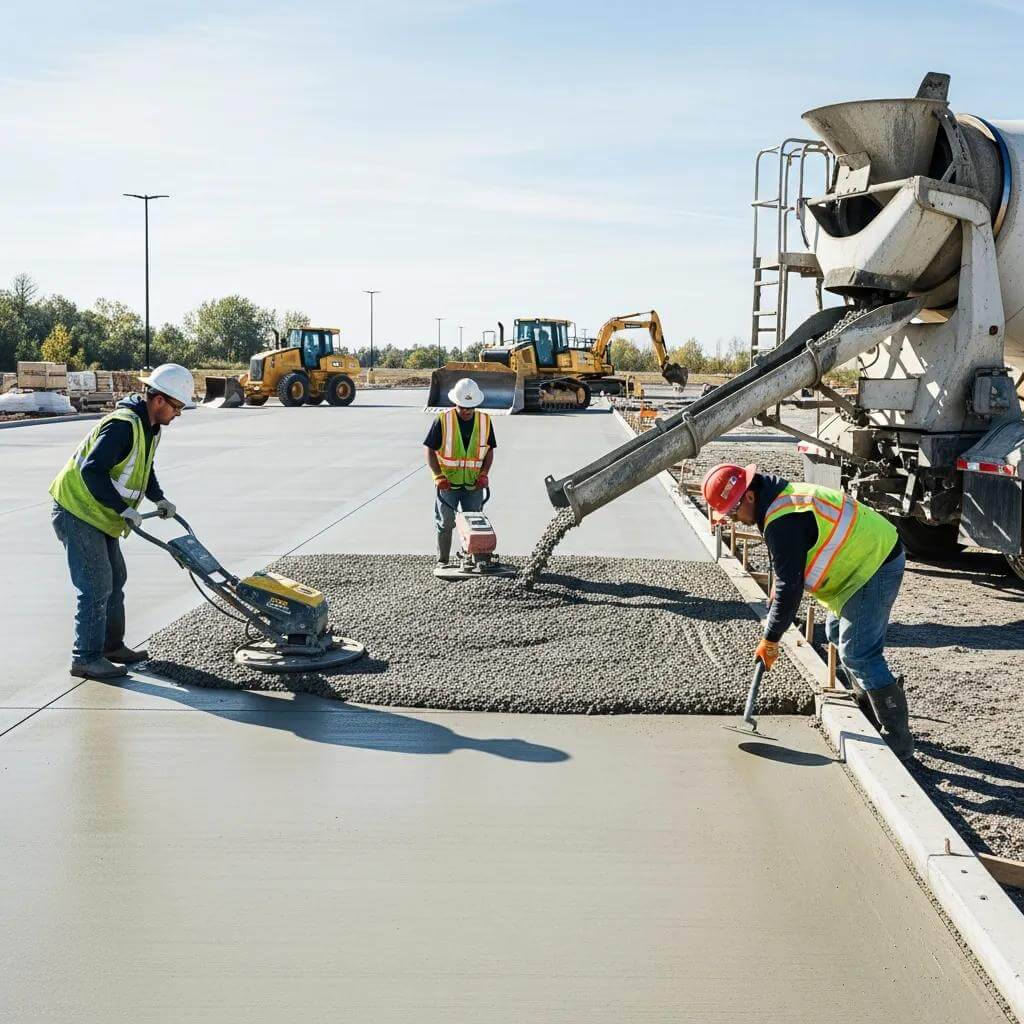
Complete Commercial Concrete Service Scope
Commercial concrete requirements vary dramatically based on facility traffic, axle weights, and hydrological exposure. We engineer site-specific flatwork solutions built to municipal CDOT, City of Colorado Springs, and Pikes Peak Regional Building Department (PPRBD) engineering standards.

Heavy-Duty Dumpster Pads & Refuse Aprons

Semi-Truck Loading Docks & Logistics Aprons

CDOT Type 2 Curb, Gutter & Valley Pans

ADA-Compliant Sidewalks, Walkways & Ramps
Heavy Industrial Slabs
- 4,500 PSI Dumpster Pads
- Semi Loading Dock Aprons
- Semi-Trailer Landing Pads
- Fueling & Bus Turnarounds
Civil & Water Drainage
- CDOT 30″ Curb & Gutter
- Valley Drainage Spillways
- Catch Basin Collars
- Concrete Flumes & Pans
Pedestrian & ADA Compliance
- ADA Continuous Walkways
- Cast-Iron Truncated Domes
- Commercial Entry Aprons
- Architectural Flatwork
Heavy-Duty Commercial Dumpster Pads & Refuse Aprons
Standard commercial front-load refuse trucks weigh between 32,000 lbs (empty) and 64,000+ lbs (fully loaded) across three axles. When these vehicles lift and drop heavy 4-to-8-yard commercial steel dumpsters, the resulting impact and static point loads cause instant shear failure in flexible asphalt.
- We install 8-to-10-inch thick, 4,500 PSI fiber-reinforced concrete pads with Grade 60 #4 rebar grids elevated on concrete chairs.
- Installations include a 15-to-25-foot reinforced approach apron to support the refuse truck’s front wheels during bin retrieval, eliminating the sunken depressions commonly seen in front of commercial enclosures.
- Explore our dedicated engineering guide: Commercial Dumpster Pad Installation & Repair in Colorado Springs.
Semi-Truck Loading Docks & Industrial Logistics Aprons
At freight terminals, regional distribution centers, and warehouse complexes along I-25 and Powers Boulevard, loaded 80,000 lb semi-trailers exert extreme hydraulic pressures. When trailers are unhooked, the steel landing gear legs concentrate up to 20,000 lbs of dead weight on two 10×10-inch steel shoes, creating point pressures exceeding 100 to 200 PSI that punch straight through asphalt.
- We pour monolithic, heavy-duty industrial dock aprons utilizing 5,000 PSI high-early-strength mixes with dual-curtain steel reinforcement.
- Poured to exact dock-leveler pit dimensions with edge-of-dock structural steel armor angles to withstand continuous forklift and yard-truck impact.
- Explore our detailed industrial guide: Concrete Loading Dock Slabs & Industrial Aprons: Colorado Springs Freight Guide.
CDOT Type 2 Curb, Gutter, and Valley Drainage Pans
Managing mountain storm runoff and winter snowmelt is vital to preserving adjacent asphalt structures. Standing water that seeps beneath curb lines saturates Class 6 road base, leading to rapid pavement failure.
- 30-Inch Curb & Gutter: Slip-form or hand-formed CDOT Type 2 (Section IIB) vertical or mountable curb and gutter profiles engineered to direct stormwater away from building foundations and into storm sewers.
- Reinforced Concrete Valley Gutters: 3-to-6-foot wide concrete drainage pans placed across high-volume parking drive lanes, providing an impermeable channel for high-velocity cross-lot runoff without eroding asphalt edges.
- Catch Basin Elevation Collars: Monolithic 8-inch reinforced concrete collars poured around storm sewer drop inlets, locking grates at exact laser grades to eliminate low-spot ponding.
- Explore our complete drainage review: Commercial Concrete Curb and Gutter Installation in El Paso County.
ADA-Compliant Commercial Sidewalks, Walkways & Ramps
Property owners face severe premises liability and civil exposure under Colorado Senate Bill 21-262 and federal ADA Title III if accessible routes feature trip hazards, uneven joints, or non-compliant slopes.
- We pour continuous pedestrian walkways meeting strict maximum 1:20 (5.0%) running slopes and 1:48 (2.08%) cross-slopes.
- Integrally poured curb ramps equipped with embedded cast-iron truncated dome detectable warning pavers, engineered to withstand heavy winter snowplow passes without chipping or shearing off.
- Explore our compliance framework: Commercial Sidewalk Repair & ADA Trip-Hazard Removal in Colorado Springs.
Regional Civil Engineering & High-Altitude Climate Challenges
Pouring commercial concrete that endures for decades in Colorado Springs requires mitigating four distinct environmental destruction mechanisms:
- ❄️ 150+ Freeze-Thaw Cycles (hydraulic pore bursting)
- 🏔️ High Altitude (6,000+ ft UV oxidation & rapid drying)
- 🌋 Expansive Bentonite Clay (5,000–10,000 PSF swell)
- 🧂 Deicing Salt Attack (magnesium chloride scaling)
1. The 150+ Annual Freeze-Thaw Thermal Shock Cycle
Colorado Springs experiences more freeze-thaw cycles than almost any other metropolitan area in the United States. Due to intense solar radiation at high altitude, daytime winter temperatures frequently reach 50°F to 60°F, melting snow and saturating concrete pore structures. Overnight, ambient temperatures plummet to 10°F or below.
- The Failure Mechanism: Trapped free water in the capillary pores expands by 9% upon freezing. If the concrete lacks microscopic relief chambers, internal hydraulic pressures rapidly exceed the tensile strength of the concrete matrix (typically 400 to 600 PSI), resulting in D-cracking, internal micro-fracturing, and surface delamination.
- The Engineered Solution: We mandate 5.0% to 8.0% microscopic air entrainment conforming to ASTM C260. These billions of microscopic, uniformly distributed air bubbles act as expansion relief chambers, allowing freezing water to expand harmlessly without disrupting the surrounding cement paste.
2. High-Altitude Atmospheric Evaporation & Wind Desiccation
At 6,000+ feet, relative humidity regularly drops below 15%, and mountain winds accelerate surface moisture evaporation.
- When the rate of surface evaporation exceeds 0.2 lbs/sq. ft./hour (per ACI 305R), the surface paste shrinks while the underlying plastic concrete remains wet, causing severe plastic shrinkage cracking before the slab even sets.
- We apply ASTM C1315 Class A membrane-forming curing compounds immediately behind final troweling, or deploy wet burlap soaking under poly sheeting to ensure full hydration and maximum surface strength.
3. Expansive Bentonite Clay Subgrades (Dawson & Denver Formations)
The soils across El Paso County, particularly in northern and eastern Colorado Springs, contain expansive smectite and bentonite clays. When unsealed concrete joints allow moisture into the subgrade, these clays swell dramatically, generating enough upward force to lift multi-ton slabs and rupture concrete curb lines.
- We mandate over-excavation of expansive subgrades, placing 4 to 8 inches of densely compacted CDOT Class 6 crushed aggregate base over non-woven geotextile stabilization fabric (Mirafi 180N) to create an unyielding foundation.
Advanced Concrete Mix Designs & Compressive Strength Engineering
The difference between concrete that lasts 5 years and concrete that lasts 40 years lies in the mix design. Residential flatwork contractors routinely pour 3,000 PSI non-air-entrained mixes with high water-cement ratios to make placement easier. In commercial environments, this results in early structural failure.
| Mix Parameter | Standard Commercial Spec | Heavy Industrial / Refuse Spec |
|---|---|---|
| Compressive Strength | 4,000 PSI @ 28 Days | 4,500 to 5,000+ PSI @ 28 Days |
| Air Entrainment | 5.5% – 7.5% (ASTM C260) | 6.0% – 8.0% (ASTM C260) |
| Water/Cement Ratio | Max 0.45 w/cm | Max 0.40 to 0.42 w/cm (Low Porosity) |
| Coarse Aggregate | CDOT #57 or #67 Crushed | 100% Fractured Crushed Granite |
| Slump Range | 3.0″ – 4.5″ (Mid-Range WR) | 4.0″ – 6.0″ (Polycarboxylate HRWR) |
| Reinforcement | Grade 60 #4 Rebar @ 18″ OC + Micro-Synthetic Fibers | Grade 60 #4/#5 Rebar @ 12″ OC + Macro-Synthetic Structural Fibers |
Why Compressive Strength (4,500+ PSI) Matters
Compressive strength directly dictates concrete’s density, abrasion resistance, and flexural fatigue threshold. A 4,500 PSI mix delivers:
- 35% Higher Flexural Strength: Resists bending and cracking under heavy delivery truck wheel loads.
- Significantly Lower Permeability: Denser crystalline microstructure limits the penetration of deicing salts and moisture.
- Higher Modulus of Elasticity: Minimizes slab deflection over Class 6 aggregate bases.
- Explore our technical guide: High-Strength Concrete Mix Specifications: 4,000 vs. 4,500+ PSI.
Structural Reinforcement: Rebar Grids on Dobies vs. Wire Mesh
Many contractors cut costs by laying welded wire mesh (WWM) directly on the ground, which ends up buried at the bottom of the slab where it provides zero structural reinforcement.
- Our Standard: We install Grade 60 deformed steel rebar tied in rigid grids on 12-to-18-inch centers.
- Crucially, every rebar intersection is supported by concrete dobies (chairs), ensuring the steel remains locked in the upper-to-middle third of the slab cross-section where tensile stresses concentrate.
- We supplement steel grids with structural macro-synthetic fibers (applied at 3.0 to 5.0 lbs/cu. yd.), distributing multi-directional tensile capacity throughout the entire concrete matrix to halt plastic shrinkage micro-fissures.
Heavy-Duty Commercial Concrete Cross-Section (Top to Bottom)
- Surface: Dense power-troweled / broom-finished wear surface
- Fiber Matrix: Macro-synthetic structural fibers throughout the slab
- Slab: 8.0″ 4,500 PSI air-entrained concrete
- Reinforcement: Grade 60 #4 rebar grid elevated mid-slab on concrete chairs / dobies
- Base: 6.0″ compacted CDOT Class 6 dense-graded crushed stone (95% Modified Proctor)
- Separation Layer: Heavy-duty non-woven geotextile fabric (Mirafi)
- Subgrade: Stabilized, moisture-conditioned subgrade soil
The 6-Phase Civil Installation & Pouring Methodology
Every commercial concrete project executed by Parking Lot Experts follows a strict, repeatable engineering protocol:
- Subgrade Proof-Rolling & Excavation
- Class 6 Base Placement & Laser Grading
- Precision Formwork & Rebar Grid Setup
- Laser Screed Placement & Consolidation
- Multi-Stage Floating & Texture Finishing
- Early-Entry Saw-Cutting & ASTM C309 Curing
Phase 1: Geotechnical Subgrade Proof-Rolling
We excavate unstable organic soils down to engineered subgrade. The exposed native ground is proof-rolled using a fully loaded 30-ton tri-axle dump truck while civil inspectors monitor for subgrade deflection, yielding, or moisture pumping. Any soft spots are undercut, stabilized with lime or cement, and lined with non-woven geotextile separation fabric.
Phase 2: Class 6 Aggregate Base & Dual-Plane Laser Grading
We import and spread 4 to 8 inches of CDOT Class 6 crushed aggregate base. Utilizing dual-plane laser-guided motor graders, the base is graded to within ±1/4 inch of design elevation and compacted in 4-to-6-inch lifts to 95%+ Modified Proctor density (ASTM D1557), verified on-site via nuclear density testing gauges.
Phase 3: Heavy-Duty Formwork & Steel Rebar Fabrication
Steel or structural timber formwork is pinned securely to grade with transit-verified elevation markers. Expansion joints (1/2-inch asphalt-impregnated fiber or closed-cell foam) are installed against existing structures, curbs, and building foundations. Grade 60 #4 or #5 rebar grids are tied and set on concrete dobies.
Phase 4: Ready-Mix Placement & Mechanical Laser Screeding
Mix temperatures, air content, and slump are tested on-site from every concrete truck. Concrete is discharged directly or placed via boom pump. We deploy mechanical laser screeds and high-frequency vibratory truss screeds that consolidate the plastic concrete, eliminate internal honeycomb voids, and strike off the surface to exact elevations.
Phase 5: Multi-Stage Finishing & Skid-Resistant Texturing
As bleed water evaporates, our finishing crews execute a multi-stage finishing process:
- Highway Bull Floating: Levels ridges and embeds large aggregate beneath the surface matrix.
- Fresno / Machine Troweling: Densifies the top paste layer to maximize wear resistance.
- Medium-Broom Finish: Applied perpendicular to vehicular and pedestrian traffic to establish an ADA-compliant, high-traction, slip-resistant surface when wet or icy.
Phase 6: Early-Entry Green Saw-Cutting & Curing Protection
Timing is critical. Within 4 to 12 hours of pouring—before internal drying stresses cause random micro-cracks—our teams execute early-entry saw cuts to relieve tensile stress. We then apply an ASTM C309 curing compound or deploy insulated thermal blankets during cold-weather conditions.
Concrete Joint Engineering: Saw-Cutting, Control Joints, and Expansion Sealing
All concrete shrinks as free mix water evaporates during hydration—roughly 1/8 inch per 20 linear feet. Without engineered joints, concrete relieves this shrinkage by cracking erratically across the surface.
- Contraction (Control) Joints: Cut to 1/4 slab depth, inducing a controlled crack below the cut line
- Spacing Rule: Max 24x to 30x slab thickness
- Timing: Early-entry saw-cut within 4 to 12 hours
- Isolation Joints: 1/2″ full-depth expansion against walls
- Joint Sealing: Polyurea / industrial silicone elastomeric sealant
The 24x–30x Slab Thickness Spacing Rule
Control joint spacing must follow precise geometric ratios:
- For a 4-inch sidewalk: 4 × 24 = 96 inches (8 feet max spacing). Standard layout is 4’x4′ or 5’x5′ square panels.
- For a 6-inch commercial apron: 6 × 24 = 144 inches (12 feet max spacing).
- For an 8-inch industrial dumpster pad: 8 × 24 = 192 inches (15 feet max spacing).
Why Joint Sealing Is Mandatory in Colorado
Unsealed control joints act as open funnels for snowmelt and road deicers. In winter, this water seeps into the joint, freezes, and causes joint spalling (raveling), while simultaneously saturating and softening the subbase beneath the slab. We seal all commercial joints with semi-rigid polyurea or self-leveling silicone sealants, forming an impermeable barrier that keeps moisture out.
Explore our joint guide: Control Joints and Expansion Joint Maintenance in Commercial Concrete Slabs.
Interconnected Commercial Concrete Cluster Architecture
Explore our comprehensive library of technical engineering guides, repair diagnostics, and municipal compliance standards across the complete Pillar 2: Commercial Concrete Services Silo:
Complete Commercial Concrete Guide Library
- Commercial Dumpster Pad Installation & Repair: Engineering for 64,000 lb refuse truck axle loads, 8-inch 4,500 PSI slabs, and rebar grid specifications.
- Concrete Loading Dock Slabs & Industrial Aprons: Heavy freight terminal engineering, landing gear punch protection, and edge armor angles.
- Commercial Concrete Resurfacing vs. Full Slab Replacement: Diagnostic criteria for surface scaling, polymer micro-toppings, and cost-benefit thresholds ($3–$6/sq ft resurface vs. $9–$15+/sq ft replacement).
- Commercial Sidewalk Repair & ADA Trip-Hazard Removal: Eliminating 1/4-inch vertical trip lips, precision horizontal saw-cutting, and Colorado SB21-262 liability compliance.
- Commercial Concrete Curb, Gutter & Valley Pan Systems: Slip-form 30-inch CDOT Type 2 curbs, concrete valley drainage pans, and catch basin retention collars.
- High-Strength Concrete Mix Specifications: 4,000 vs. 4,500+ PSI: ASTM C260 air entrainment, water-cement ratios (< 0.45), and macro-synthetic fibers vs. Grade 60 steel.
- Cold-Weather Commercial Concrete Pouring in Colorado: ACI 306R cold-weather standards, heated mix water, non-chloride accelerators, and insulated thermal curing blankets.
- Control Joints and Expansion Joint Maintenance: Early-entry green saw-cutting timing, 24x–30x spacing rules, and polyurea joint sealing.
- Protecting Commercial Concrete from Winter Salt & Spalling Damage: Mitigating magnesium chloride scaling with penetrating silane/siloxane sealers.
- Commercial Stamped & Decorative Concrete: High-traffic architectural entryways, integral color hardeners, and winter slip-resistant textures.
Cross-Silo Integration with Asphalt Paving & Site Development
A complete commercial property relies on seamless engineering transitions between rigid concrete and flexible asphalt:
- Asphalt Milling & Tie-Ins: When paving overlays, our crews mill precise edge-keys along concrete curbs and drainage pans, ensuring the asphalt matches the concrete elevation without creating trip hazards. Explore Asphalt Milling & Overlay.
- ADA Slope Transitions: Accessible parking stalls paved in asphalt must transition seamlessly into concrete curb ramps at a maximum slope of 1:12 (8.33%). Explore ADA Compliance & Colorado Striping Regulations.
- Stormwater Runoff Integration: Asphalt drive lanes must be graded at 1.5% to 2.0% slopes to discharge runoff into concrete valley gutters and curb pans. Explore The Commercial Paving Process.
Commercial CapEx Budgeting & Lifecycle Cost Analysis
While commercial concrete requires a higher initial capital expenditure than asphalt, its Total Cost of Ownership (TCO) over 30 to 40 years makes it the most cost-effective pavement material for high-stress zones:
| Service Classification | Average Cost | Expected Structural Lifespan |
|---|---|---|
| Standard Commercial Walkways (4″–5″ 4,000 PSI Reinforced) | $8.50 – $12.00 / sq. ft. | 30 to 40+ Years |
| Heavy Industrial Slabs (8″–10″ 4,500–5,000 PSI) | $11.00 – $16.50+ / sq. ft. | 35 to 50+ Years |
| CDOT 30″ Curb and Gutter (Slip-Form / Hand-Poured) | $28.00 – $42.00 / lin. ft. | 30 to 40+ Years |
| Polymer Concrete Resurfacing (Micro-Toppings / Overlays) | $3.50 – $6.50 / sq. ft. | 8 to 15 Years |
| ADA Trip-Hazard Saw-Cutting | $65.00 – $110.00 / hazard | Permanent (until soil shifts) |
30-Year Financial Comparison: Dumpster Approach Pad
Asphalt Apron (Flexible)
- Initial Install: $4,500
- Rutting / Shear Repairs (Every 3–4 Years @ $2,500): $20,000
- Total 30-Year Cost: $24,500 (plus constant tenant disruption and safety risk)
Reinforced Concrete Pad (Rigid 8″ 4,500 PSI)
- Initial Install: $9,200
- Routine Joint Resealing (Every 7 Years @ $400): $1,600
- Total 30-Year Cost: $10,800
💰 Net 30-Year Savings with Concrete: $13,700 (56% Capital Savings)

Frequently Asked Questions
Why is commercial concrete so much more expensive upfront than asphalt?
Commercial concrete requires significantly higher material and labor inputs. Concrete utilizes manufactured Portland cement, mined aggregates, chemical admixtures (air entrainment, water reducers), and heavy Grade 60 steel rebar grids supported on concrete chairs. The formwork, laser screeding, multi-stage troweling, joint saw-cutting, and 7-day curing process require specialized skilled trade labor. However, concrete lasts 30 to 40+ years with minimal maintenance, whereas asphalt requires sealcoating every 3 years and major resurfacing every 12 to 15 years.
How soon can commercial vehicles drive on a newly poured concrete slab?
For standard 4,000 to 4,500 PSI commercial mixes, pedestrian foot traffic is safe after 24 to 48 hours. Passenger vehicles may drive on the slab after 7 days (when the concrete has achieved approximately 70% of its design compressive strength). Heavy delivery trucks, 64,000 lb garbage haulers, and semi-trailers must remain off the slab for a minimum of 14 to 28 days unless a high-early-strength mix (such as a 3-day 3,500 PSI accelerator mix) has been specified.
What is the primary cause of concrete spalling and surface scaling in Colorado Springs?
Surface spalling is almost always caused by freeze-thaw expansion combined with winter deicing chemicals acting on non-air-entrained concrete or concrete that was finished with excess bleed water. When deicing salts melt snow, the brine penetrates surface capillary pores. When it refreezes, osmotic pressure forces the top 1/8 to 1/4 inch of cement paste to flake off, exposing the coarse aggregate beneath. Applying penetrating silane/siloxane sealers and specifying 5% to 8% air entrainment prevents this failure mode.
What is the maximum allowable slope for ADA commercial sidewalks?
Under ADA Accessibility Guidelines (ADAAG Section 403) and Colorado SB21-262, a continuous pedestrian walkway must maintain a maximum running slope of 1:20 (5.0%) without being classified as a ramp. Any walkway with a running slope steeper than 5.0% must be engineered as an ADA ramp (maximum slope 1:12 or 8.33%) equipped with continuous handrails. The maximum allowable cross-slope across any accessible walkway is 1:48 (2.08%).
Can cold-weather concrete be poured during Colorado Springs winters?
Yes. Commercial concrete can be poured safely year-round in Colorado Springs by adhering to ACI 306R (Guide to Cold Weather Concreting). When ambient temperatures are below 40°F, batch plants heat the mix water and aggregates. We utilize non-chloride chemical accelerators, insulate formwork, and cover freshly placed slabs with heavy insulated curing blankets for 3 to 7 days, maintaining a minimum internal concrete temperature of 50°F to ensure proper hydration before the slab is exposed to freezing conditions.
Partner with Colorado Springs’ Premier Commercial Concrete Contractors
Don’t let cracked dumpster pads, sunken loading docks, or dangerous sidewalk trip hazards undermine your property value and expose your business to premises liability claims.
Partner with Parking Lot Experts for heavy-duty commercial flatwork, certified ADA slope engineering, laser-guided curb and gutter installations, and industrial slabs built to endure the Colorado climate.
Schedule Your On-Site Commercial Concrete Assessment
- Company: Parking Lot Experts
- Headquarters: 3318 Adobe Ct., Colorado Springs, CO 80907
- Direct Office Phone: +1 (719) 465-6690
- Email: info@parkinglotexperts.com
- Service Area: Colorado Springs, El Paso County, Monument, Falcon, Fountain, Castle Rock, and the Greater Denver Metro Area.
Local Info
Commercial Concrete Contractors Colorado Springs
Commercial Concrete Contractors Near Me
Parking Lot Experts is proud to serve the Colorado Springs, Colorado community with professional commercial concrete, asphalt paving, concrete paving, sealcoating, striping, crack repair, and site preparation.Whether you’re a business, municipality, or property owner, we provide long-lasting pavement solutions tailored to the unique climate and soil conditions of the Pikes Peak region.
Business Name: Parking Lot Experts
Address: 3318 Adobe Ct, Colorado Springs, CO 80907, United States
Google Map: https://share.google/tGnzbNfQY3IojMDeG
Phone Number: +1 719-465-6690
Hours: Monday-Friday, 8 am–4 pm
{
“@context”: “https://schema.org”,
“@type”: “LocalBusiness”,
“name”: “Parking Lot Experts”,
“url”: “https://parkinglotexperts.com/”,
“telephone”: “+1-719‑465‑6690”,
“email”: “aaron@parkinglotexperts.com”,
“description”: “Parking Lot Experts, based in Colorado Springs, CO, specializes in asphalt and concrete paving, seal coating, parking lot striping, crack repair, and site preparation. Serving Colorado Springs, Denver, and the surrounding areas, we deliver durable and cost-effective pavement solutions with local expertise.”,
“image”: “https://parkinglotexperts.com/wp-content/uploads/2025/01/parking-lot-experts-logo.webp”,
“areaServed”: [
{“@type”: “AdministrativeArea”, “name”: “Colorado Springs”},
],
“openingHoursSpecification”: [{
“@type”: “OpeningHoursSpecification”,
“dayOfWeek”: [“Monday”,”Tuesday”,”Wednesday”,”Thursday”,”Friday”],
“opens”: “08:00”,
“closes”: “16:00”
}],
“sameAs”: [“https://www.facebook.com/parkinglotexperts”],
“hasMap”: “https://www.google.com/maps/place/Parking+Lot+Experts/data=!4m2!3m1!1s0x0:0xa6aa051f8f529c1b?sa=X&ved=1t:2428&ictx=111“,
“founder”: {
“@type”: “Person”,
“name”: “Aaron Smith”,
“jobTitle”: “Founder & Owner”
},
“contactPoint”: {
“@type”: “ContactPoint”,
“contactType”: “customer service”,
“telephone”: “+1-719‑465‑6690”,
“email”: “aaron@parkinglotexperts.com”,
“areaServed”: “US”
},
“keywords”: [
“asphalt paving”,”concrete paving”,”parking lot maintenance”,
“seal coating”,”parking lot striping”,”pavement repair”,
“crack sealing”,”site preparation”,”grading”,”resurfacing”
]
}
About Colorado Springs, CO
Located at the base of Pikes Peak, Colorado Springs is the second-largest city in Colorado and a hub for outdoor recreation, military presence, and growing businesses. The city has a population of nearly 500,000 residents and sits at an elevation of 6,035 feet, which creates unique conditions for pavement maintenance — from freeze-thaw cycles to heavy summer storms.
Colorado Springs is home to Peterson Space Force Base, Fort Carson, and the U.S. Air Force Academy, making it one of the most strategically important cities in the country. Popular attractions include Garden of the Gods, Broadmoor Seven Falls, and the Cheyenne Mountain Zoo.
For businesses, Colorado Springs’ expanding commercial districts — including Downtown, Northgate, Powers Corridor, and Briargate — require reliable infrastructure such as paved parking lots, walkways, and roadways.
Directions from Colorado Springs Airport (COS)
If you’re visiting Parking Lot Experts or scheduling a project in Colorado Springs:
From Colorado Springs Airport (COS): Take Milton E. Proby Parkway west to Powers Blvd (CO-21 N). Continue north, then connect to Platte Ave or I-25 depending on project location. Most job sites are within 20–30 minutes of the airport.
Parking Lot Contractor Reviews
Parking Lot Experts has built a strong reputation in Colorado Springs and Denver for quality paving and customer-first service. See why we are the Top Parking Lot Contractors in Colorado Springs:
Google Reviews: https://www.google.com/search?sca_esv=0fe9578549ba645d&rlz=1C5CHFA_enAR1029AR1029&biw=1440&bih=700&si=AMgyJEtREmoPL4P1I5IDCfuA8gybfVI2d5Uj7QMwYCZHKDZ-E4arYuGkBL6g8Kig7XTSz5594FZT2vtPaIFRdZcan7ONTAIHNXWR5oIbk5p8uVLxzZvO1tIa2dGlNiJS-aNYHWAxAhqnW5YzYfkOtW-pKJKtJdFFgg%3D%3D&q=Parking+Lot+Experts+Reviews&sa=X&ved=2ahUKEwiVhoq4rN-PAxUthf0HHYTxF4kQ0bkNegQIJhAE
Customers consistently note:
- Durable results – projects designed to withstand Colorado’s climate
- Clear communication – hands-on owner involvement
You may have found us by searching for some other common contractor services:
Paving Contractor Colorado Springs
Concrete paving contractors El Paso County
Concrete Contractor Colorado Springs
Asphalt Contractor Colorado Springs
Asphalt paving Colorado Springs
Parking lot striping near me
Nearby Service Areas
Cities & Towns Served:
- Colorado Springs
- Manitou Springs
- Fountain
- Monument
- Woodland Park
- Castle Rock
- Denver
Counties Served:
- El Paso County
- Teller County
- Douglas County
- Arapahoe County
- Denver County
Neighborhoods in Colorado Springs:
- Briargate
- Old Colorado City
- Northgate
- Broadmoor
- Downtown Colorado Springs
- Powers Corridor
- Falcon / Black Forest
Zip Codes Served:
80903 (Downtown), 80906 (Broadmoor), 80907 (North Central), 80918 (Northeast), 80920 (Briargate), 80921 (Northgate), 80922 (East), 80923 (Powers Corridor), 80924 (Wolf Ranch), 80817 (Fountain), 80132 (Monument)

