


Commercial parking lot paving in Colorado Springs and the Front Range varies by surface type, grading, and drainage needs, with asphalt and concrete carrying different upfront and long-term cost profiles. Parking Lot Experts helps property managers budget accurately before construction begins.
Key Takeaways
- Paving costs for new asphalt parking lots depend on site conditions, grading, drainage, and material specifications; pricing varies by project and is best confirmed with a site-specific quote.
- Parking Lot Experts serves Colorado Springs, Denver, Manitou Springs, Fountain, Monument, Woodland Park, and Castle Rock.
- Complete paving projects include grading, drainage, ADA compliance, striping, and lighting for comprehensive lot solutions.
- Contact Parking Lot Experts at 719-465-6690 for Front Range commercial paving estimates.
What Does Commercial Parking Lot Paving Cost Per Square Foot?
Commercial parking lot paving cost per sq ft typically shows up as a shorthand figure that property managers search for first when budgeting a project. A single number rarely tells the whole story, though. Sidewalk works as a layered system, and the final price depends on subgrade conditions, drainage needs, and traffic load, not surface area alone.
Property managers across Colorado Springs and the broader Front Range often compare bids using this per-square-foot shorthand, assuming it functions as a complete specification. Industry guidance warns against that assumption. Dollars per square foot describes
How Does Colorado Springs Pricing Compare Nationally?
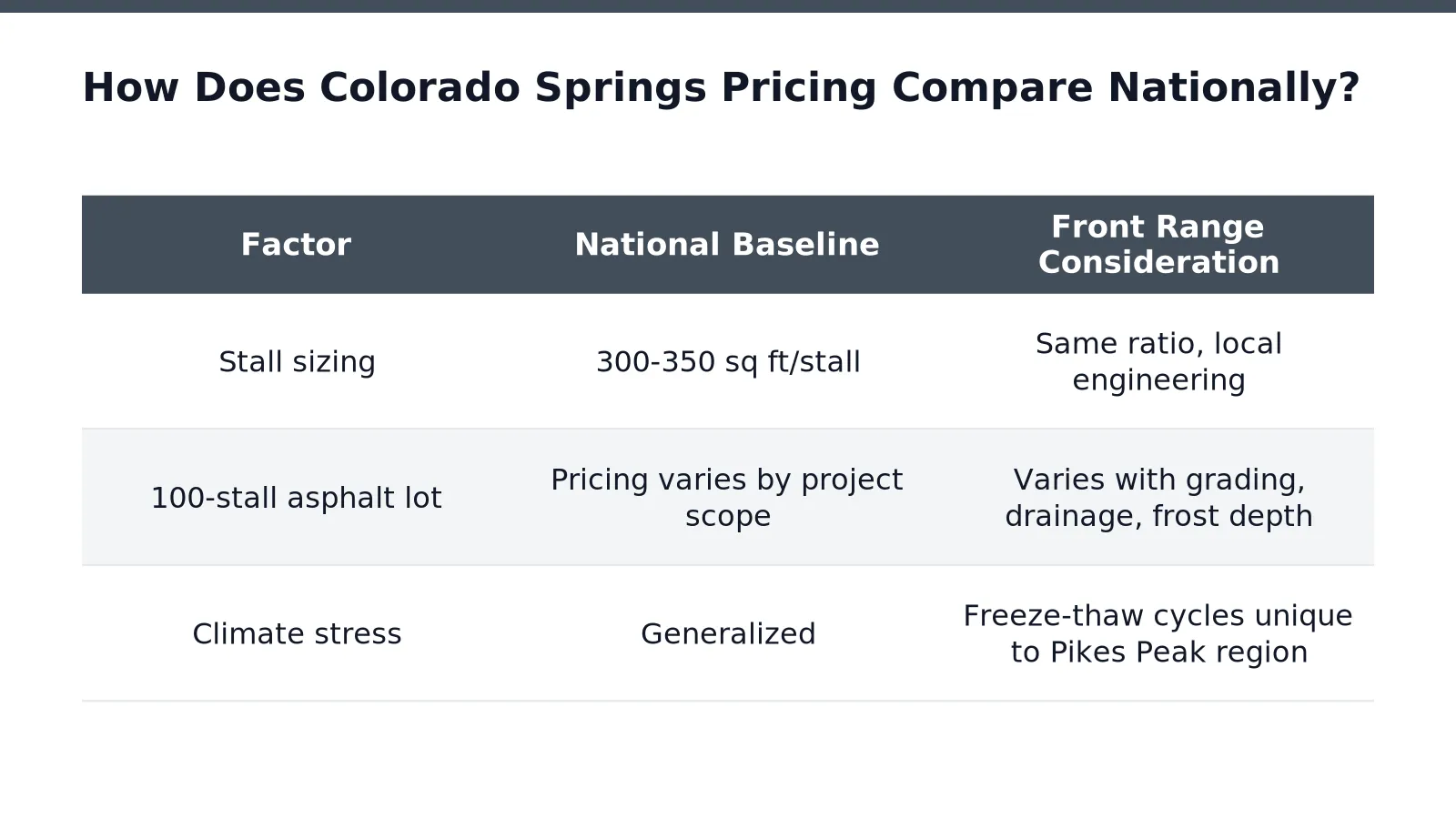
National baselines offer a useful starting point for Front Range budgeting, but regional conditions shift the final number. Each parking stall, including its share of drive aisles and circulation space, consumes roughly 300 to 350 square feet of paved area nationwide. That ratio matters because commercial parking lot paving cost per sq ft calculations always scale up to a per-stall figure before a property manager signs off on a budget.
A clean 100-stall asphalt lot built on apartment, dry ground represents the most favorable scenario for budgeting. It assumes ideal site conditions: no major grading, no drainage complications, no frost-related subgrade issues. Pikes Peak region terrain rarely offers that luxury, which is why an accurate project-specific estimate matters more than a generalized national figure.
Parking lot paving cost Colorado projects factor in soil behavior and freeze-thaw cycles that don’t appear in flatland national averages. Sidewalk systems built for Colorado Springs and the surrounding Front Range account for the region’s distinct climate and soil conditions, since subgrade stability shifts with seasonal temperature swings in ways that don’t match coastal or southern climates. This localized engineering approach explains why asphalt paving cost Colorado Springs quotes can diverge from generic national square-footage figures found online.
Why Does Location Change Repaving Costs So Much?
Soil composition, drainage requirements, and seasonal freeze-thaw stress all vary by region. Each factor changes how a sidewalk base performs over time. The cost to repave commercial parking lot surfaces along the Front Range reflects these site-specific demands rather than an apartment national rate.
| Factor | National Baseline | Front Range Consideration |
|---|---|---|
| Stall sizing | 300-350 sq ft/stall | Same ratio, local engineering |
| 100-stall asphalt lot | Pricing varies by project scope | Varies with grading, drainage, frost depth |
| Climate stress | Generalized | Freeze-thaw cycles unique to Pikes Peak region |
Property managers working across Colorado Springs, Denver, and surrounding communities benefit from providers familiar with these regional variables. Consistent local pricing expertise helps avoid budget surprises tied to soil and climate factors that national averages simply don’t capture. Parking Lot Experts serves this territory with that regional focus in mind.
What Factors Drive Paving Costs Along the Front Range?
Multiple engineered layers determine paving expenses along Colorado’s Front Range: site preparation, subgrade compaction, base installation, surface placement, and finishing work such as striping and drainage. Each layer adds labor, material, and equipment costs that shape the final commercial parking lot paving cost per sq ft for property managers budgeting a new lot or a repave.
Site conditions across the region create real variation. Coverage spanning El Paso, Teller, Douglas, Arapahoe, and Denver counties means parking lot paving cost colorado projects differ sharply. Soil composition, drainage patterns, and existing base conditions change from one county to the next. A lot built on sandy soil near Colorado Springs requires different subgrade preparation than a clay-heavy site farther north toward Denver.
Climate plays an equally large role in asphalt paving cost colorado springs estimates. Properly engineered surfaces must withstand Colorado’s freeze-thaw cycles, intense UV exposure, and heavy seasonal traffic, which pushes contractors toward thicker base layers and higher-grade materials than milder climates require. Cutting corners on these specifications shortens sidewalk life and invites premature cracking.
Quality construction matters just as much on a private roadway or driveway as it does on a full commercial lot. Durability and long-term value depend on consistent engineering standards, regardless of project size.
What affects the cost to repave a commercial parking lot?
Repaving expenses hinge on the condition of the existing base, the extent of drainage corrections needed, and whether striping and ADA markings require full replacement. A lot with a sound subgrade typically needs far less excavation than one with widespread subsurface damage. The cost to repave commercial parking lot surfaces often rises sharply once hidden base failures surface during demolition.
Primary cost drivers include:
- Subgrade compaction and soil stability
- Base material thickness and grading
- Drainage design and correction needs
- Finishing work, including striping and markings
- Regional climate exposure from freeze-thaw cycles, UV, and snow load
Asphalt or Concrete: Which Costs More Locally?
Concrete carries a higher price tag than asphalt for Front Range parking lots, both upfront and over time. Asphalt wins on initial investment and installation speed. Concrete wins on lifespan and reduced upkeep, a tradeoff every Colorado Springs property manager eventually weighs.
The gap shows up clearly once budgets get translated into per-stall numbers. Nationally, concrete lots carry a higher per-stall cost than asphalt lots, reflecting heavier material and labor demands during construction. For a facility manager comparing bids, understanding the commercial parking lot paving cost per sq ft for each material matters more than chasing the lowest headline number.
| Factor | Asphalt | Concrete |
|---|---|---|
| Upfront cost | Lower | Higher per stall |
| Installation speed | Faster | Slower |
| Lifespan | 25-35 years with upkeep | Longer, with lower maintenance needs |
| Maintenance | Requires periodic sealing/repair | Minimal ongoing care |
Does asphalt really last 25 years in Colorado?
Properly built and maintained asphalt lots last 25 to 35 years before requiring replacement. Neglect changes that math fast. A lot without regular sealing or crack repair can fail in under a decade, especially given the Front Range’s freeze-thaw cycles and intense UV exposure.
Which material fits most commercial sites along the Front Range?
Most commercial property owners weighing parking lot paving cost Colorado budgets choose asphalt first. Lower upfront spending frees capital for other improvements. Larger facilities with longer planning horizons sometimes favor concrete instead, accepting higher initial asphalt paving cost Colorado Springs comparisons in exchange for decades of reduced maintenance. Either way, understanding the cost to repave commercial parking lot surfaces under each material helps property managers plan capital expenditures with fewer surprises down the road.
What Does Repaving a Commercial Lot Cost?
Repaving costs for a commercial lot in Colorado Springs depend heavily on how much deterioration has already occurred. Front Range asphalt surfaces face intense sun exposure, wide temperature swings, and heavy vehicle traffic, all of which accelerate surface wear over time. Left unaddressed, that wear pattern determines whether a property manager faces a modest maintenance bill or a full-scale reconstruction project.
Commercial parking lot paving cost per sq ft varies based on the extent of damage and the repair method chosen. Properties that catch surface wear early often qualify for lower-cost interventions, while those with deep structural failure require full-depth repaving at a higher price point.
Why Does Timing Affect Repaving Cost?
Timing matters because sidewalk damage compounds. A lot with minor surface cracking can often be treated with slurry seal, a cost-effective mixture of asphalt emulsion, fine aggregate, and water that renews the surface and delays expensive repairs. Once cracking progresses to base failure, slurry seal no longer applies, and full repaving becomes the only remaining option.
Does Maintenance Lower Long-Term Repaving Costs?
Yes. Resurfacing and sealcoating restore the surface, improve appearance, and extend sidewalk life, pushing the eventual repaving timeline further out. Property managers who budget for these interim treatments typically spread parking lot paving cost Colorado property owners face across several smaller expenses rather than one large capital outlay.
Several factors shape asphalt paving cost Colorado Springs businesses should expect when comparing repaving against lighter treatments:
- Current sidewalk condition and depth of cracking
- Drainage issues contributing to base damage
- Traffic volume and vehicle weight load
- Whether curb appeal and safety upgrades are part of the scope
A professionally installed asphalt surface improves curb appeal, strengthens safety, and delivers longer-lasting performance, which directly affects the economics of repaving versus simple patching. For many Colorado Springs facility managers, the cost to repave commercial parking lot surfaces becomes a question of timing: act during early wear, and the investment stays manageable.
How Does Colorado’s Climate Affect Paving Costs?
Colorado’s freeze-thaw cycles raise paving costs by forcing thicker base layers and denser asphalt mixes. Daytime thaw followed by nighttime freeze pushes moisture into surface cracks, then expands that moisture into ice, widening every weak point in the sidewalk. Property managers across the Front Range feel this reality every time a bid comes back higher than expected.
Local contractors familiar with Colorado Springs understand how freeze-thaw patterns interact with heavy vehicle traffic. That understanding shapes both material choice and final project price. Asphalt mixes installed in the region are engineered to withstand Colorado’s swinging temperatures alongside daily traffic loads, a specification decision that factors directly into asphalt paving cost colorado springs quotes. Skimping on mix design to save money upfront often backfires within a few winters, leading to premature cracking and a shorter sidewalk lifespan.
Why Does Elevation Change Sidewalk Wear?
Elevation changes exposure risk significantly. Woodland Park and Monument sit at higher elevation than Colorado Springs or Denver, which means more freeze-thaw cycles each season and faster surface degradation. Fountain, Castle Rock, Manitou Springs, and the Denver metro area each carry their own temperature-swing profile, so parking lot paving cost colorado estimates vary by jurisdiction and site elevation.
Sidewalk across the region wears from both traffic and weather exposure over time. That is why climate-aware maintenance budgeting matters as much as the original installation.
| Climate Factor | Cost Impact |
|---|---|
| Freeze-thaw frequency | Thicker base, higher material cost |
| Elevation | More cycles at altitude, faster wear |
| Traffic volume | Denser mix specification |
When Does Resurfacing Become Cheaper Than Repair?
A realistic commercial parking lot paving cost per sq ft accounts for freeze-thaw exposure, elevation, and traffic load before a single ton of asphalt arrives on site. Once cracking spreads past isolated patches, the cost to repave commercial parking lot surfaces often runs lower over the long term than repeated spot repairs. Full resurfacing resets the sidewalk’s resistance to Colorado’s seasonal extremes.
What Maintenance Costs Should Facility Managers Expect?
Maintenance budgets for Colorado Springs and Front Range parking lots center on preventive treatments rather than full reconstruction. Facility managers who schedule regular upkeep avoid the steep costs tied to premature repaving. Chief among these treatments is slurry seal, a mixture of asphalt emulsion, fine agg
FAQ
What is the average cost per square foot for commercial parking lot paving in Colorado Springs?
Commercial parking lot paving costs $4 to $10 per square foot in 2026 across Colorado Springs and the Front Range, depending on surface type, grading, and drainage needs.
How much does an asphalt or concrete parking stall cost to pave?
Asphalt lots average $1,500 to $3,000 per stall. Concrete lots run $3,000 to $6,000 per stall, with each stall consuming roughly 300 to 350 square feet including drive aisles.
Why do Front Range paving costs differ from national averages?
Colorado Springs pavement systems account for freeze-thaw cycles, soil behavior, and subgrade stability unique to the region, causing local quotes to diverge from generic national square-footage figures.

