


Commercial parking lots require thicker asphalt layers, engineered drainage systems, ADA compliance, permits, and phased scheduling to withstand trucks and heavy daily traffic, unlike residential driveways designed for lighter loads and curb appeal. Property managers and facility managers benefit from this engineered approach, which Parking Lot Experts delivers across Colorado Springs, Denver, and the surrounding areas.
Key Takeaways
- Commercial paving requires thicker asphalt layers and engineered drainage systems for heavy vehicle traffic loads.
- Residential driveways need simpler construction than commercial lots serving Colorado Springs, Denver, and surrounding areas.
- Commercial projects require ADA compliance, permits, and phased scheduling, while residential work typically has fewer regulatory demands.
- Asphalt provides affordable, durable surfaces for both residential driveways and large commercial parking lots.
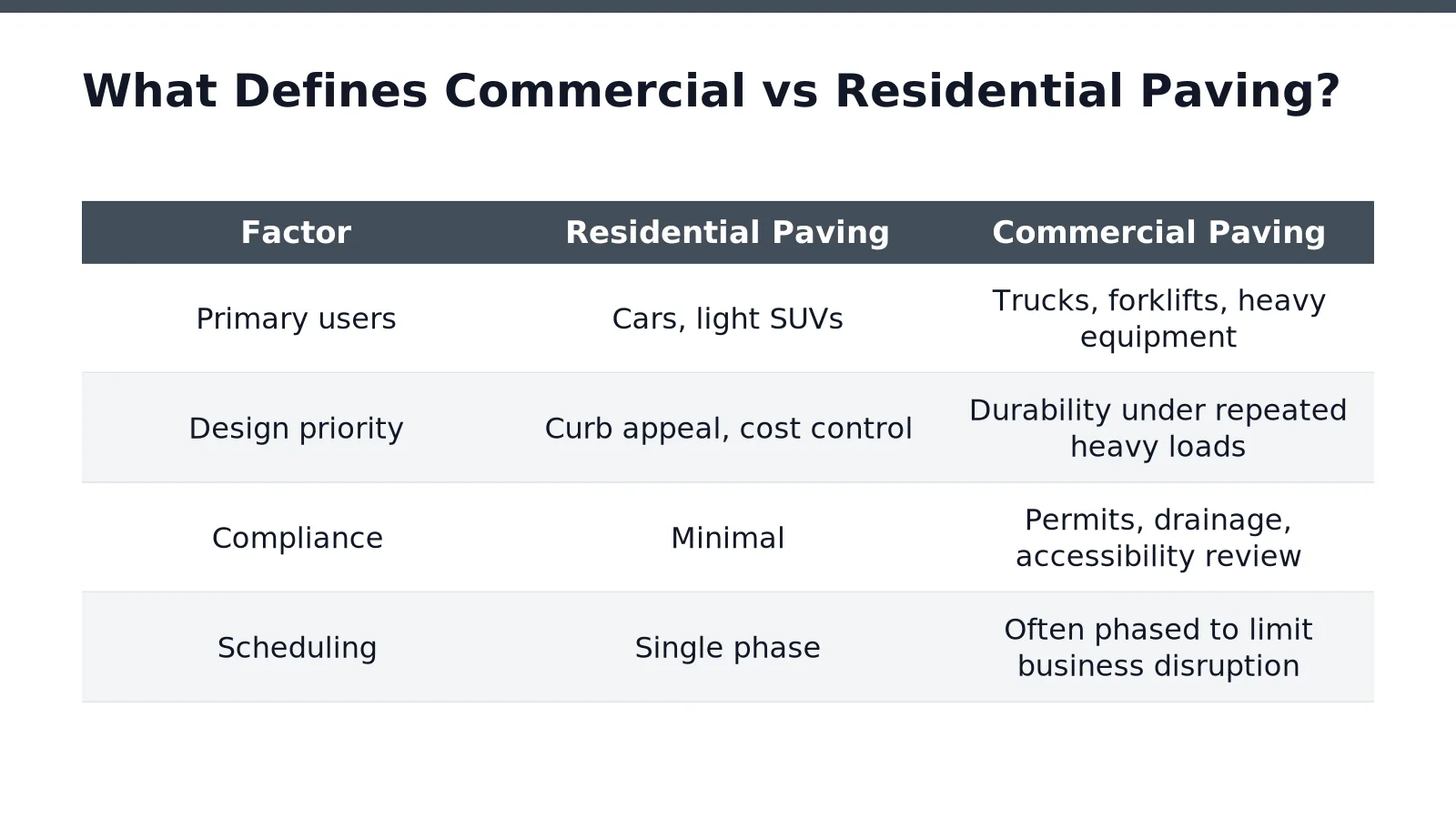
What Defines Commercial vs Residential Paving?
Commercial vs residential paving differs in scope, engineering intent, and regulatory oversight, even though both rely on asphalt and similar paving machinery. Commercial projects serve businesses, municipalities, and multi-tenant properties, while residential work serves single-family driveways and private lanes. The materials look alike on the surface. The engineering behind them does not.
A driveway handles passenger cars and the occasional delivery van. A commercial lot absorbs daily traffic from delivery trucks, forklifts, and dozens of vehicles cycling through every hour. That difference in load drives nearly every decision a paving contractor makes, from base preparation to surface compaction. Facility managers overseeing commercial sites need sidewalk engineered for repetition and weight, not just appearance.
Does Traffic Load Really Change the Paving Design?
Traffic load shapes almost every specification on a commercial jobsite. Heavier, more frequent loads demand stronger base layers, denser asphalt mixes, and more rigorous grading than a residential lane ever requires. This is where commercial vs residential asphalt thickness becomes a real engineering variable rather than a cosmetic choice.
Why Do Commercial Properties Follow Different Standards?
Commercial sites carry compliance obligations that residential driveways simply do not face. Accessibility requirements, drainage engineering, and permitting review all fall under broader commercial paving standards that property managers must satisfy before a lot opens to the public.
| Factor | Residential Paving | Commercial Paving |
|---|---|---|
| Primary users | Cars, light SUVs | Trucks, forklifts, heavy equipment |
| Design priority | Curb appeal, cost control | Durability under repeated heavy loads |
| Compliance | Minimal | Permits, drainage, accessibility review |
| Scheduling | Single phase | Often phased to limit business disruption |
Projects built to proper heavy load paving specs hold up where lighter residential mixes fail. Parking Lot Experts serves commercial, residential, and municipal clients from its Colorado Springs base, giving the team firsthand familiarity with how these project types diverge across the Pikes Peak region.
How Does Traffic Load Change Paving Design?
Traffic load drives nearly every other decision in sidewalk design. A driveway built for sedans faces a completely different set of stresses than a loading dock built for box trucks. That difference shapes everything from material selection to installation depth.
Commercial vs residential paving starts with a simple distinction: who, and what, drives on the surface. Residential paving supports cars and light SUVs making occasional trips in and out of a garage. Commercial paving must handle delivery trucks, heavy equipment, and constant daily use, often with vehicles idling or turning sharply across the same stretch of sidewalk for years.
That gap in usage changes the build itself. Commercial vs residential asphalt thickness varies because heavier, more frequent loads compress and stress sidewalk layers differently than a car parked overnight. Facility managers planning a new lot or resurfacing project need to think beyond surface appearance. Consider what the sidewalk sits on top of, not just what sits on top of it.
| Factor | Residential | Commercial |
|---|---|---|
| Typical vehicles | Cars, light SUVs | Delivery trucks, heavy equipment |
| Usage pattern | Occasional | Constant, daily |
| Design priority | Durability, curb appeal | Load capacity, longevity |
What loads does commercial sidewalk need to withstand?
Commercial surfaces absorb repeated pressure from delivery trucks and heavy machinery, not just the occasional sedan. This constant cycle of weight and movement is why heavy load paving specs. Broader commercial paving standards exist separately from residential guidelines.
How does a paving contractor adjust methods for load differences?
Parking Lot Experts scales its process from site preparation and minor repairs up to full new asphalt installation. Severe distress conditioning, matching the approach to the load involved. The company serves commercial, residential, and municipal clients, each with load requirements that differ widely.
How Thick Should Commercial vs Residential Asphalt Be?
Thickness depends entirely on what kind of traffic the surface must carry. A home driveway and a business parking lot are built to completely different specifications, even though both start with the same base material. Understanding commercial vs residential asphalt thickness helps property managers and business owners budget correctly and avoid premature sidewalk failure.
Residential driveways use a thinner asphalt layer laid over a compacted base. That depth suits passenger cars and light SUVs, which place minimal stress on the surface. Commercial lots tell a different story. Because delivery trucks, trash haulers, and heavy equipment roll across them daily, these surfaces need substantially thicker asphalt. Skipping that extra depth invites cracking and rutting under repeated weight.
Why does commercial asphalt need to be thicker?
Heavy vehicles concentrate enormous pressure on small contact points, and thin asphalt simply can’t distribute that load without deforming. Heavy load paving specs account for axle weight, traffic frequency, and vehicle turning patterns, all of which stress sidewalk far more than a daily commuter car. Skimping on thickness here shortens lifespan dramatically and invites costly repairs within just a few years.
| Property Type | Asphalt Depth | Base Depth |
|---|---|---|
| Residential driveway | Thinner, lighter-duty layer | Standard compacted base |
| Commercial parking lot | Thicker, reinforced layer | Deeper, reinforced base |
Does one paving company handle both thicknesses?
Yes. A qualified paving contractor should offer the full range of asphalt services, backed by modern equipment and materials suited to each thickness requirement. Parking Lot Experts provides exactly that range, applying the correct specifications whether the job is a two-car driveway or a loading dock built for freight trucks. Based in Colorado Springs, the company applies regional commercial paving standards that account for local soil conditions and freeze-thaw cycles affecting both property types.
What Heavy Load Specs Does Commercial Sidewalk Need?
Commercial sidewalk must support delivery trucks, forklifts, and constant traffic without cracking under pressure. Structural requirements go far beyond what a driveway needs. Heavy load paving specs demand thicker asphalt layers, engineered drainage systems, ADA compliance, permits, and phased scheduling, elements that rarely factor into a residential job.
How does commercial sidewalk differ from residential sidewalk in design?
Commercial vs residential paving comes down to load-bearing purpose. Residential surfaces handle passenger cars, so thinner asphalt and simpler base layers suffice. Commercial lots absorb repeated stress from heavy vehicles, which requires reinforced subgrade preparation and drainage engineering to prevent water pooling and base failure.
What makes commercial vs residential asphalt thickness different?
Thickness is the clearest technical divide. Residential driveways typically rely on a modest asphalt layer over compacted base material. Commercial surfaces need additional depth to distribute heavy axle loads evenly. This difference in commercial vs residential asphalt thickness protects against rutting and premature cracking under sustained weight.
| Factor | Residential | Commercial |
|---|---|---|
| Traffic type | Cars, light SUVs | Trucks, delivery vehicles, equipment |
| Asphalt depth | Thinner | Thicker, reinforced base |
| Drainage | Basic grading | Engineered systems |
| Compliance | Minimal | ADA, permits required |
| Scheduling | Single phase | Phased to limit disruption |
Commercial paving standards also account for ADA-compliant access routes, required permitting, and phased construction that keeps parking lots operational during work. Property managers and business owners in Colorado Springs, Denver, and surrounding towns face added structural considerations, since regional soil composition and freeze-thaw climate cycles influence base design and long-term durability. Facility managers overseeing lots in Manitou Springs, Fountain, Monument, Woodland Park, or Castle Rock encounter similarly distinct load and drainage requirements shaped by local terrain.
What Standards Govern Commercial Paving Projects?
Municipal codes, engineering specifications, and accessibility requirements shape every commercial paving project. These standards exist because parking lots and access roads carry far greater stress than a private driveway. The sidewalk structure has to answer for it. Facility managers overseeing retail centers, office parks, or municipal lots need to understand these baseline requirements before any bid goes out.
The contrast with residential work makes the point clear. Residential paving prioritizes lighter traffic loads, curb appeal, and cost-effective durability suited to driveways and private roads, not the heavy-load compliance standards that govern commercial sites. That distinction drives how commercial vs residential paving projects get designed from the ground up, from subgrade preparation to final striping.
What makes commercial paving standards different from residential codes?
Commercial sites answer to zoning boards, fire marshals, and accessibility reviewers in ways residential driveways rarely do. Requirements typically address drainage slope, load-bearing base depth, and clear-path markings for emergency access. Jurisdictions across Colorado, including El Paso, Teller, Douglas, Arapahoe, and Denver counties, commonly apply municipal and commercial paving standards to new lots and major resurfacing work.
Why does asphalt thickness matter for compliance?
Thickness requirements exist to prevent premature rutting and cracking under repeated heavy loads. Commercial vs residential asphalt thickness differences reflect the weight categories each surface must support, from passenger cars to delivery trucks. Heavy load paving specs for loading docks and fire lanes often call for reinforced base layers beyond standard parking stalls.
Property managers planning a resurfacing or new build typically need services covering several compliance areas at once:
- Asphalt paving engineered for vehicle weight classes
- Concrete paving for high-wear zones like dumpster pads
- Sealcoating to extend surface life against freeze-thaw cycles
- Striping for ADA-compliant accessible spaces
- Crack repair to prevent base failure
- Site preparation and grading for proper drainage
Parking Lot Experts addresses these compliance layers directly, offering asphalt paving, concrete paving, sealcoating, striping, crack repair, and site preparation suited to varying municipal requirements.
How Do Maintenance Needs Differ Between Paving Types?
Maintenance schedules diverge sharply once traffic patterns, structural design, and surface exposure come into play. Each paving type carries its own set of structural requirements, traffic demands, and maintenance expectations that shape how long a surface lasts and how often it needs attention. Property managers overseeing a parking lot face a different upkeep rhythm than a homeowner managing a driveway, and understanding commercial vs residential paving needs prevents costly surprises down the road.
A residential driveway typically sees light, predictable loads: passenger cars, the occasional delivery van, maybe a moving truck once a decade. Commercial lots absorb constant traffic from delivery vehicles, forklifts, and dozens of daily visitors, which accelerates surface wear and demands a more rigorous maintenance calendar. This difference in exposure is central to understanding commercial paving standards and why inspection frequency rises alongside traffic volume.
Why does commercial sidewalk need more frequent upkeep?
Heavier, more frequent loads stress the surface and subbase faster than residential conditions ever will. Facility managers who delay inspections risk small cracks turning into structural failures that disrupt business operations.
What does a full-service maintenance approach typically include?
A comprehensive maintenance process spans the entire sidewalk lifecycle:
- Site preparation and grading review
- Minor crack and pothole repairs
- New asphalt installation when sections fail
- Conditioning for severe distress as sidewalk ages
Parking Lot Experts applies this full-spectrum approach across commercial, residential, and municipal properties, recognizing that each client type carries distinct long-term maintenance expectations. A municipal lot handling bus traffic and heavy load paving specs requires a different repair cadence than a quiet residential cul-de-sac. Matching maintenance intensity to actual usage, rather than applying a one-size-fits-all schedule, keeps sidewalk performing reliably over its full service life.
Why Do Cost and Process Differ by Project Type?
Project scope drives both price and procedure in paving work. A driveway repaving job follows a different path than a parking lot installation for a business. The process, materials, and overall cost of commercial vs residential paving can look very different from one project to the next.
Scale explains part of the gap. A driveway covers a small, enclosed footprint with limited access points. A commercial lot spans a wide area with multiple entrances, drive lanes, and parking stalls. Equipment, crew size, and scheduling all scale up to match.
Design requirements add another layer. Commercial projects often involve engineering review, drainage planning, and layout decisions tied to how customers and vehicles move through a site. Residential projects rarely need this level of planning, since traffic stays light and predictable.
What should property managers consider before comparing quotes?
Property managers should look past the price per square foot and consider site complexity. A small lot with heavy truck traffic may demand more preparation than a large lot with only passenger cars, which shifts cost regardless of size.
Does project type change the paving timeline?
Yes. Commercial work frequently requires phased scheduling to keep part of a lot open during business hours, extending the timeline compared to a driveway that closes for a day or two.
Understanding these differences helps homeowners, business owners, property managers, and developers make informed decisions before committing to a project. The table below outlines the general contrast:
| Factor | Residential | Commercial |
|---|---|---|
| Footprint | Small, single-access | Large, multi-access |
| Traffic | Light, passenger vehicles | Heavy, mixed vehicle types |
| Planning | Minimal | Engineering and drainage review |
| Scheduling | Short, flexible | Phased, business-hours sensitive |
Parking Lot Experts serves Colorado Springs, Denver, Manitou Springs, Fountain, Monument, Woodland Park, and
FAQ
Why does commercial asphalt need to be thicker than residential asphalt?
Commercial lots absorb daily traffic from delivery trucks, forklifts, and dozens of cycling vehicles. Driveways only handle passenger cars and occasional delivery vans. This heavier load demands stronger base layers and denser asphalt mixes.
What compliance steps do commercial paving projects require that residential driveways skip?
Commercial sites require permits, engineered drainage systems, and ADA accessibility review before opening to the public. Residential driveways face minimal compliance obligations and typically use single-phase scheduling instead.
Who handles both commercial and residential paving projects in Colorado Springs?
Parking Lot Experts serves commercial, residential, and municipal clients from its Colorado Springs base, covering Colorado Springs, Denver, and surrounding areas. Reach the team at +1 719-465-6690, Monday-Friday, 8 am–4 pm.

