


Colorado commercial parking lot construction follows 10 phases, from site assessment through final striping, with subgrade preparation serving as the most critical step for preventing premature failure. Asphalt installation runs $2 to $4.50 per square foot, while a standard 100-space lot averages $75,000. Properly built asphalt sidewalk lasts 25 to 35 years, and Parking Lot Experts delivers this construction expertise across Colorado developments.
Key Takeaways
- Asphalt parking lots cost $2 to $4.50 per square foot; concrete runs $4 to $7 per square foot.
- A standard 100-space asphalt lot averages $75,000 in total construction costs for Colorado developers.
- Parking lot construction follows 10 distinct phases, with subgrade preparation being the most critical step.
- Professional teams including architects and landscape specialists ensure successful commercial parking lot development projects.
What Is Parking Lot Construction in Colorado?
Parking lot construction in Colorado covers every phase of turning raw or existing land into a durable vehicle surface, from initial site grading through final striping. A parking lot is often the first physical interaction a customer has with a business. Construction quality becomes a visible reflection of a property’s standards. A cracked, pooling, or poorly marked lot signals neglect before a visitor ever reaches the front door.
Colorado’s freeze-thaw cycles and intense UV exposure put extra strain on sidewalk. Experienced parking lot builders approach this work differently than crews in milder climates. New construction paving colorado projects must account for soil expansion, snowmelt drainage, and seasonal temperature swings. Any shortcut in these early decisions can crack an otherwise sound surface within just a few seasons.
What Does Commercial Parking Lot Construction Include?
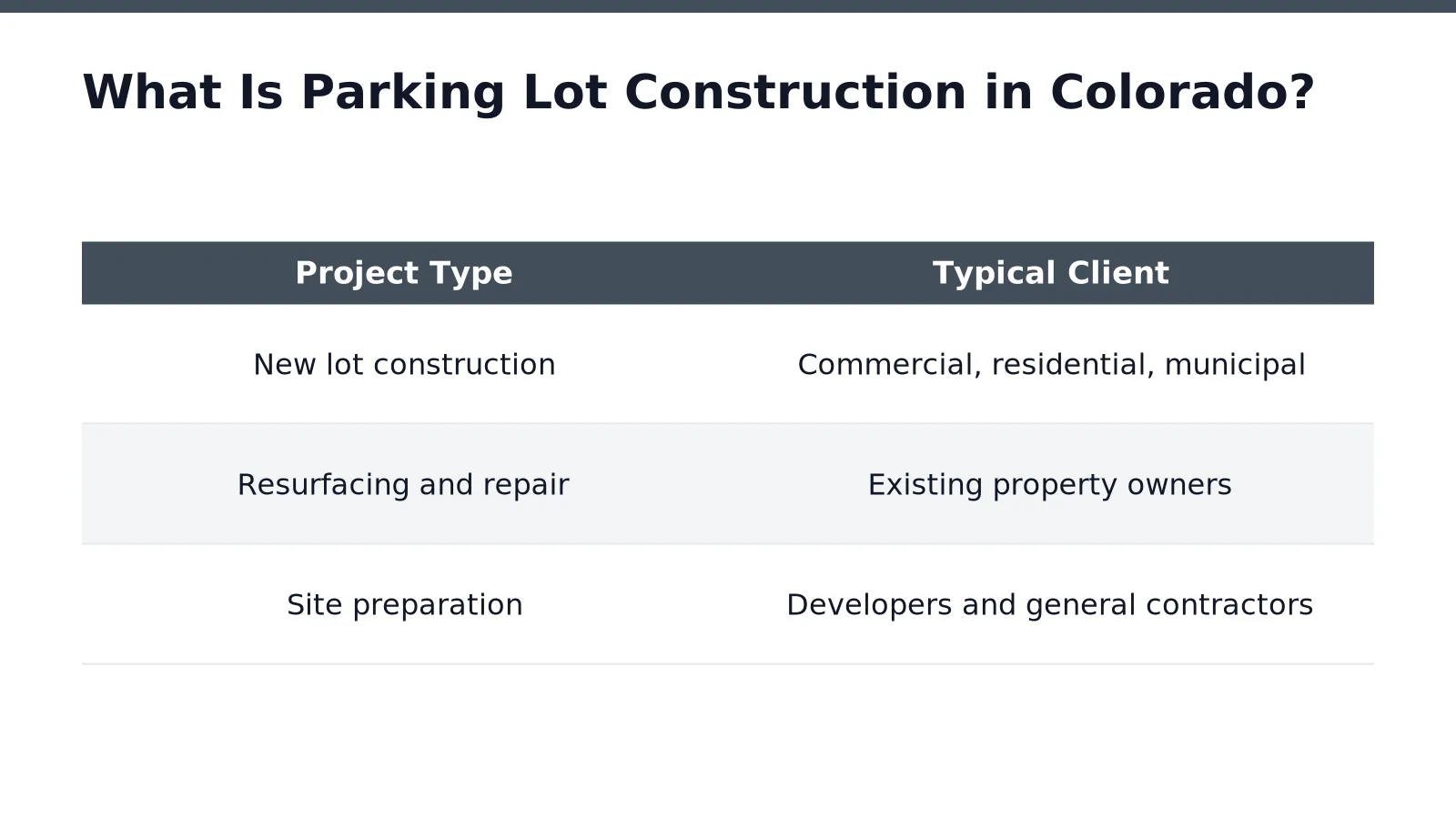
Commercial parking lot site development typically bundles several services into one coordinated project: excavation, grading, drainage installation, base compaction, paving, and striping. Property managers overseeing retail centers, office parks, or municipal facilities rely on this bundled approach to avoid juggling separate contractors for each step.
| Project Type | Typical Client |
|---|---|
| New lot construction | Commercial, residential, municipal |
| Resurfacing and repair | Existing property owners |
| Site preparation | Developers and general contractors |
Why Does Site Preparation Matter So Much?
New parking lot site prep and subbase work determines whether a lot survives Colorado winters or fails within a few years. Weak subbase compaction lets water infiltrate, freeze, expand, and crack the surface above it. Facility managers who skip this step often face repair bills far sooner than planned.
Parking Lot Experts provides professional asphalt paving, concrete paving, sealcoating, striping, crack repair, and site preparation across the Colorado Springs community, serving commercial, residential, and municipal clients alike.
What Are the Main Phases of Building a Lot?
Ten distinct phases carry a new parking lot from site assessment through final striping. Each phase builds on the one before it, so skipping a step anywhere in the sequence weakens everything that follows. Property managers and business owners in Colorado benefit from understanding this order before signing off on a project timeline.
The early phases set the foundation, literally. Site assessment and grading come first, followed by subbase preparation, a stage that determines how well the sidewalk holds up against freeze-thaw cycles common across Colorado’s higher elevations. New parking lot site prep and subbase work matters more than most property owners realize. Weak groundwork is the leading cause of cracking and sinking years later. Paving, compaction, and curing follow, with drainage planning woven throughout to keep water from pooling on the surface.
How long does a new asphalt lot last if built correctly?
A properly built and maintained asphalt lot lasts between 25 and 35 years. That lifespan depends entirely on whether the earlier phases, especially subbase compaction, were done correctly. Cutting corners early shortens that window considerably, often forcing costly repairs within the first decade.
Who typically handles each phase of lot construction?
Specialized parking lot builders usually manage the sequence, coordinating grading crews, paving crews, and striping teams. New construction paving Colorado projects often require site-specific adjustments for soil type and elevation, which general contractors without paving focus may overlook.
Final phases include striping, signage, and ADA compliance checks. Companies offering commercial parking lot site development typically provide full-service oversight across all ten phases. Parking Lot Experts provides complete asphalt installation and construction services for new lots, building across Colorado Springs, Denver, and the surrounding areas.
Why Does Site Prep and Subbase Matter Most?
Subgrade preparation ranks as the single most critical step in parking lot construction. Rushing or skipping proper soil compaction causes more premature sidewalk failures than any other construction mistake. Everything placed above the subgrade, including the subbase layer and the final asphalt or concrete surface, depends on that foundation holding steady under repeated loads. Skilled parking lot builders treat this groundwork as the project’s backbone rather than a step to rush through.
New construction paving in Colorado contends with conditions many states never face. Freeze-thaw cycles, expansive clay soils, and sharp elevation changes all push and pull at sidewalk from below. Solutions need to match the climate and soil behavior found across the Pikes Peak region, where temperature swings and moisture levels shift within a single season. A subbase built for a apartment, dry climate will not survive those pressures for long.
Commercial parking lot site development begins long before any paving crew shows up. Site assessment, soil testing, and grading all shape how the finished lot performs for years afterward. Reliable workmanship and properly engineered layers are necessary to withstand Colorado’s changing climate and the weight of delivery trucks, forklifts, and daily customer traffic. Property managers who skip these early steps often see cracking, potholing, and drainage problems within just a few years.
What Happens If Subbase Work Gets Rushed?
Skipping compaction or grading leaves voids and soft spots beneath the surface. Those weak points shift under vehicle weight, and the sidewalk above cracks or sinks in response. Water collects in the depressions, freezes, and expands, accelerating the damage each winter.
How Does Soil Vary Across Colorado Communities?
New parking lot site prep and subbase design has to account for real differences in soil and drainage from one Colorado community to the next:
- Colorado Springs and Manitou Springs, where elevation and rocky terrain affect drainage
- Fountain and Monument, with varying clay content in native soils
- Woodland Park and Castle Rock, where higher elevation brings sharper freeze-thaw exposure
- Denver, where urban grading and existing infrastructure shape subbase decisions
Sidewalk planned without local soil testing risks failure long before its expected lifespan ends.
How Does Colorado’s Climate Shape Construction Choices?
Colorado’s wide swings in temperature and elevation dictate nearly every material and scheduling decision on a paving project. Sun exposure, freeze-thaw cycles, and heavy traffic load wear down even premium asphalt surfaces over time, which means sidewalk built for Front Range conditions needs more resilience than a standard regional mix. Parking lot builders working across the state account for these stresses before the first truck of material arrives.
Elevation and microclimate shift dramatically depending on where a site sits. Commercial parking lot site development in Denver County looks different from a project near mountain-adjacent Teller County. Colder nights and heavier snow loads demand thicker base layers and different drainage planning. El Paso, Douglas, and Arapahoe Counties each bring their own soil and moisture patterns into the equation as well.
Why Does Local Experience Matter for Colorado Paving Projects?
A contractor based in the region understands seasonal sidewalk stress in ways an out-of-state crew often cannot. Familiarity with local freeze-thaw patterns, UV intensity, and soil behavior shapes smarter decisions on mix design and timing, reducing the odds of premature cracking or surface failure.
What Role Does Site Prep Play in Climate-Resistant Sidewalk?
New parking lot site prep and subbase work forms the foundation that determines how well a lot handles Colorado’s seasonal extremes. A properly compacted subbase resists the heaving caused by repeated freezing and thawing, while adequate drainage planning keeps moisture from undermining the structure below.
New construction paving Colorado projects typically weigh several climate factors during planning:
- Freeze-thaw frequency and its effect on subgrade stability
- Elevation-driven temperature swings across different counties
- UV exposure and its long-term impact on asphalt binders
- Snow and moisture drainage requirements by region
Protective treatments such as slurry seal applications offer a cost-effective way to extend sidewalk life before wear from sun, weather, and traffic turns into costly structural repairs.
What Does Commercial Parking Lot Site Development Involve?
Commercial parking lot site development brings together architects, civil engineers, site planners, and several other specialists who coordinate design and construction decisions before any paving equipment arrives on-site. Property managers overseeing a new lot often underestimate how many disciplines touch a single project. Skipping that coordination risks drainage failures, permit delays, and sidewalk that cracks within a few seasons instead of lasting decades.
Commercial parking lot site development functions less like a single contract and more like a relay race between specialists. Civil engineers calculate grading and water flow. Site planners map traffic patterns and parking counts. Environmental consultants and attorneys may also weigh in depending on the parcel. Each handoff shapes what happens on the ground later, including how the sidewalk itself gets built.
How is a commercial paving project organized from start to finish?
Commercial development generally follows a staged structure rather than one continuous build. The process opens with site selection and feasibility analysis. The parcel gets evaluated for slope, soil conditions, and traffic capacity. Later stages shift toward design finalization and physical construction, which is where new parking lot site prep and subbase work determines how long the finished surface actually holds up.
Typical stages include:
- Site selection and feasibility review
- Design, engineering, and permitting
- Site preparation, subbase installation, and final paving
Who builds commercial parking lots across Colorado?
Parking lot builders operating across Colorado handle projects ranging from small residential driveways to large commercial facilities. New construction paving Colorado projects demand subbase systems built to withstand heavy traffic loads and freeze-thaw cycles common throughout the state. Parking Lot Experts delivers this full range of asphalt construction work, scaling crews and materials to match each site’s traffic demands and soil conditions.
How Much Does New Construction Paving Cost in Colorado?
New construction paving in Colorado costs between $2 and $4.50 per square foot for asphalt. Concrete runs $4 to $7 per square foot. Those figures shift based on lot size, soil conditions, and the complexity of drainage and grading work required before any sidewalk goes down. For property managers budgeting a project, the square-footage range offers a starting point, but it rarely tells the whole story.
Total project costs span a wide gap, from roughly $5,000 for a small lot to $700,000 or more for a large commercial site. A regional medical office with twenty spaces sits at one end of that range. A multi-building retail development with hundreds of spaces, heavy drainage requirements, and extensive commercial parking lot site development sits at the other. Size alone doesn’t determine the final number; subsurface conditions and site access matter just as much.
Why does paving cost vary so much between projects?
Costs vary because every site in Colorado brings its own soil profile, slope, and drainage challenge. A lot built on expansive clay needs deeper excavation. A more robust subbase than one built on stable, well-draining ground. New parking lot site prep and subbase work, often invisible once the final surface is laid, accounts for a large share of the budget swing.
Is resurfacing cheaper than new construction?
Resurfacing and sealcoating cost less than full replacement and extend the life of a worn surface without a complete rebuild. These methods work best when the underlying base remains sound and only the top layer shows wear. Full new construction becomes necessary once the subgrade itself has failed.
Property managers weighing these options can request project-specific pricing directly. Parking Lot Experts provides cost estimates by phone for owners comparing parking lot builders across Colorado projects. new construction paving colorado quotes typically require a site visit to confirm final numbers.
What Compliance and Code Factors Apply in Colorado?
Colorado code compliance for parking facilities hinges on accessibility standards, structural safety margins, and client-specific obligations that shift depending on the property type. Accessible design, drainage, and striping requirements apply across commercial, residential, and municipal properties. The depth of review often depends on who owns the lot and how it gets used. Skipping a step in this review process risks failed inspections, costly rework, and liability exposure down the road.
Does ADA Compliance Work the Same Way for Every Property?
No. Compliance obligations differ by client type. commercial parking lot site development carries different code triggers than a residential drive or a municipal facility. Commercial properties typically face stricter accessible-route and signage review tied to public use. Municipal lots often answer to additional oversight tied to public funding. Consulting support exists specifically to help owners track these distinctions, with national-level advisory services covering parking lot asset management, ADA compliance, and contractor operations as separate but related disciplines.
Why Does Structural Parking Carry Tighter Margins?
Multi-level and structured parking facilities leave almost no room for error. Waterproofing, post-tensioning, and ramp geometry all demand precise execution. A small deviation in any one of these systems can compromise the entire structure’s long-term safety and performance.
Site-level factors matter just as much as design specifications. Groundwork for new parking lot site prep and subbase has to account for Colorado’s freeze-thaw cycles before any compliance checklist gets signed off. For firms engaged in new construction paving Colorado projects, familiarity with regional inspection expectations, built through a Colorado Springs presence, supports smoother coordination with local code officials. The table below outlines where compliance scrutiny tends to concentrate:
| Client Type | Primary Compliance Focus |
|---|---|
| Commercial | Accessible routes, signage, public-use code |
| Residential | Drainage, setback, basic accessibility |
| Municipal | Funding-tied oversight, public accessibility standards |
How Do You Choose Qualified Parking Lot Builders?
Qualified parking lot builders design installation, repair, and maintenance work around one goal: maximizing the lifespan and durability of the asphalt surface. Colorado property managers evaluating contractors for new construction paving colorado projects should look past the lowest bid. Examine the full scope of services offered. A contractor that only installs sidewalk, without a maintenance plan, leaves Colorado’s freeze-thaw cycles to do their damage unchecked.
Material quality separates a lot that lasts decades from one that cracks within a few winters. Premium materials and professional application techniques produce a consistent, long-lasting finish. Shortcuts on either front show up fast once snowplows and temperature swings hit the surface. Property managers overseeing commercial parking lot site development in Denver or Colorado Springs should ask prospective builders directly what materials they use. Why, rather than assuming all asphalt mixes perform the same.
What questions should property managers ask before hiring a paving contractor?
Property managers should ask how the contractor approaches new parking lot site prep and subbase work. Subgrade preparation determines whether the finished surface holds up under heavy traffic. Questions worth raising include:
- What steps does the crew take during site prep before paving begins?
- Which materials and sealing methods does the company use for long-term durability?
- Does the contractor offer ongoing maintenance, or only one-time installation?
How can property managers reach a paving contractor to discuss a project?
FAQ
How much does a commercial parking lot cost in Colorado?
Asphalt installation costs $2 to $4.50 per square foot, while concrete runs $4 to $7 per square foot. A standard 100-space asphalt lot averages $75,000 in total construction costs.
What is the most critical phase of parking lot construction?
Subgrade preparation is the most critical step in the 10-phase construction process. ### How long does a properly built asphalt parking lot last?
Properly built asphalt sidewalk lasts 25 to 35 years. Parking Lot Experts delivers this construction expertise to commercial, residential, and municipal clients across Colorado Springs, Denver, and surrounding areas.
Conclusion
In closing, building a new commercial parking lot in Colorado demands careful planning, quality materials, and expert execution, elements that distinguish successful projects from costly mistakes. By partnering with experienced local professionals who understand regional climate challenges. Compliance requirements, developers secure durable infrastructure that protects their investment for years to come. The right sidewalk partner transforms your parking lot from a necessary expense into a lasting asset that enhances property value and client satisfaction.

